How to Become a Massage Therapist: A Step-by-Step Guide
Training hours, the MBLEx and state licence rules differ widely, so here is the order to tackle them in and what each stage actually asks of you.
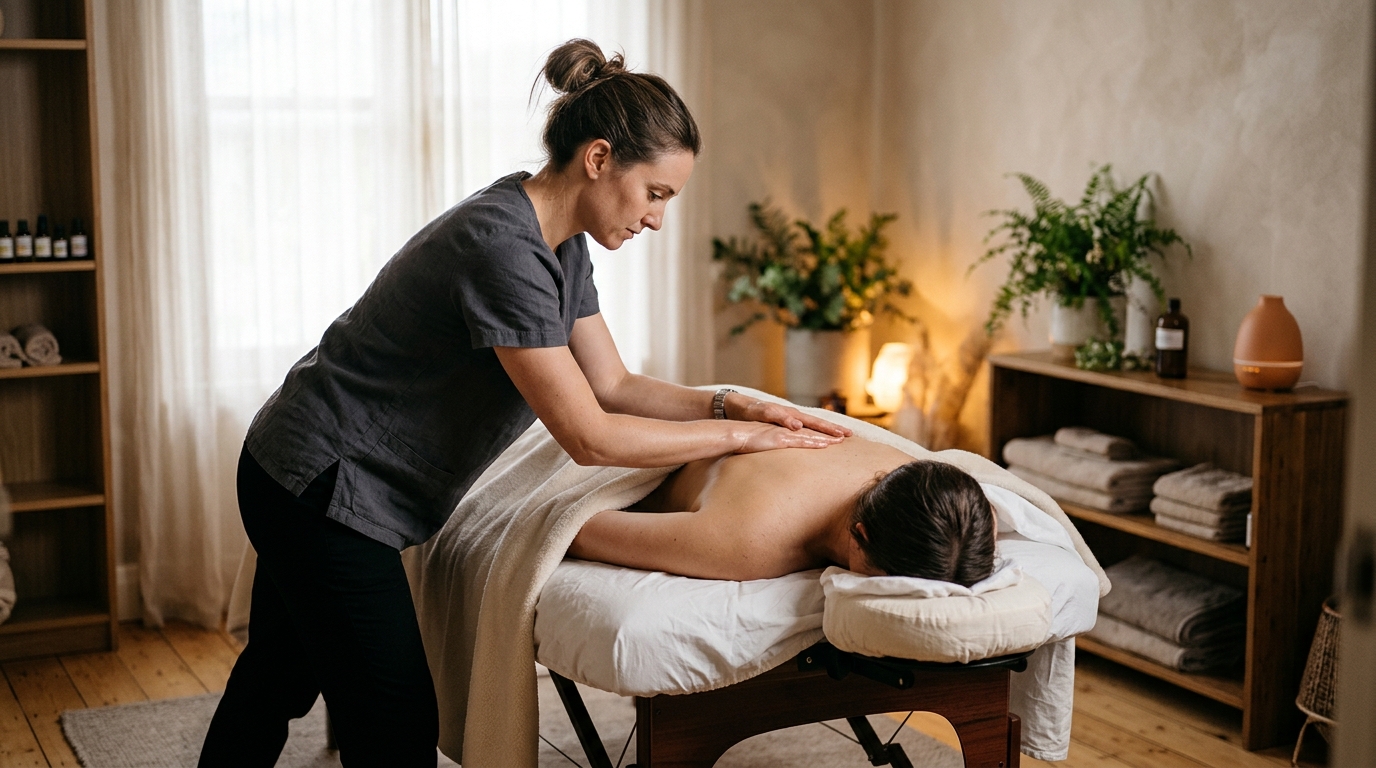
Becoming a massage therapist means completing a board-approved training program, passing a licensing exam — in most states the MBLEx, created by the Federation of State Massage Therapy Boards — and then applying to your state board before you touch a paying client. The required hours vary a lot by state: Washington State sets at least 625 hours completed over no fewer than 24 weeks, Alabama a minimum of 650 hours, and Nebraska at least 1,000 hours.
The work itself is part clinical and part commercial: you take client histories, plan and document treatment, keep the room clean and stocked, and manage your own bookings. This guide walks through the sequence, the realistic timing, and where to look up pay and licensing rules for your state.
What the Job Involves Day to Day
Most shifts begin with the schedule. You open the online appointment manager, see who is booked, and read back through notes from each returning client's last visit. Scheduling and calendar software is a normal part of the toolkit for this occupation (O*NET OnLine, 2026), whether you work for a clinic or for yourself.
Each appointment opens with an intake conversation. You confer with the client about their medical history and about problems with stress or pain, then decide how massage can help and whether anything in their history means you should modify or decline treatment (ONET OnLine, 2026). From that you develop and propose a treatment plan specifying which types of massage you will use — deep tissue, Swedish, trigger point, sports work — and you keep a treatment record afterwards (ONET OnLine, 2026).
Then comes the hands-on hour or half-hour, usually standing, usually repeated several times in a row. Between clients you reset: strip and remake the table, sanitise equipment, restock oils, linens and supplies (O*NET OnLine, 2026).
The rest of the week is business admin — confirming bookings, following up on rebooks, tracking continuing education for licence renewal, and renewing insurance. Alabama, for example, requires evidence of $1,000,000 in personal liability coverage (Alabama Board of Massage Therapy), and Idaho licences renew annually (CareerOneStop, U.S. Department of Labor).
Skills and Traits That Help You Succeed
- Applied anatomy, physiology and kinesiology. You need these to find the muscle a client is actually describing, and they are tested directly on the MBLEx alongside pathology, client assessment and ethics (Federation of State Massage Therapy Boards). Washington State's required curriculum covers all of these areas plus a student clinic (Washington State Department of Health).
- Palpation and pressure control. Learnable through supervised practice hours: reading tissue by hand and adjusting depth so a deep tissue session relieves a stiff neck rather than leaving the client sore for days.
- Clinical documentation. Writing treatment plans and keeping treatment records is listed as a core task for the occupation (O*NET OnLine, 2026). SOAP-style notes let you pick up where you left off six weeks later and protect you if a complaint is filed.
- Scheduling and point-of-sale software. Online appointment managers are a named tool for this work (O*NET OnLine, 2026). You will be booking, rescheduling, taking payment and handling no-shows yourself unless a front desk does it for you.
- Careful questioning about health history. Intake means asking about medication, recent surgery, pregnancy and injury, then telling a client you cannot work on an area today — a conversation that needs to be clear, not apologetic.
- Physical stamina and body mechanics. Several sessions back to back are hard on thumbs, wrists and lower back. Good table height and stance is the difference between a long career and a two-year one.
- Boundary setting. You work on undressed clients in a quiet room. Knowing and stating draping rules and scope of practice protects both of you; NCBTMB Board Certification requires agreement to uphold its Standards of Practice (NCBTMB).
How to Break Into This Career
- Read your state board's rules first — 1 to 2 weeks. Hour requirements differ substantially: Washington State requires at least 625 hours completed in no fewer than 24 weeks (Washington State Department of Health), Alabama a minimum of 650 hours from an accredited school (Alabama Board of Massage Therapy), and Nebraska at least 1,000 hours from an approved program (CareerOneStop, U.S. Department of Labor). Training that satisfies one state may not satisfy another.
- Confirm you meet basic eligibility — before you enrol. Idaho requires a high school diploma or equivalent and that you be 18 or older; Nebraska sets the minimum age at 19 (CareerOneStop, U.S. Department of Labor). Most states also run a criminal background check at licensure.
- Enrol in a board-approved massage therapy program — roughly 6 to 12 months full time, longer part time. The U.S. Bureau of Labor Statistics (2025) lists a postsecondary education program as the typical entry-level education for massage therapists. Expect classroom anatomy, pathology and ethics plus a supervised student clinic, which is a required component in Washington State.
- Prepare for and pass the MBLEx — commonly 4 to 8 weeks of revision alongside or after your program. The Massage & Bodywork Licensing Examination was created by the Federation of State Massage Therapy Boards as a standardised entry-level assessment, and is a 100-question, computer-adaptive, multiple-choice exam covering anatomy and physiology, kinesiology, pathology, client assessment and ethics. Apply and pay the application fee through FSMTB; check its site for the current fee. Nebraska accepts the MBLEx or an approved NCBTMB exam; Idaho requires a nationally recognised competency exam approved by its board.
- Apply for your state licence and arrange insurance — 2 to 8 weeks for processing. Submit transcripts, exam results and background check. Alabama requires evidence of $1,000,000 in personal liability insurance coverage before you practise.
- Take an entry-level post and build hours — first paycheque within weeks of licensure. Reported job titles for the occupation include Licensed Massage Therapist (LMT) and Certified Massage Therapist (CMT) (O*NET OnLine, 2026); spas, massage franchises, chiropractic offices and physical therapy clinics are the usual first employers. Later, Board Certification in Therapeutic Massage and Bodywork (BCTMB) from the National Certification Board for Therapeutic Massage and Bodywork — accredited by the National Commission for Certifying Agencies — requires a current state licence, a passing background check and agreement to its Standards of Practice, with no minimum practice experience requirement.
Typical Timeline From Start to First Job
These milestones follow the six steps above in the same order. Treat them as a full-time pace; part-time study stretches the middle stages.
- Weeks 1–2: You have read your state board's requirements and know your hour total — 625, 650, 1,000 or something else — and whether the MBLEx or an approved NCBTMB exam is accepted.
- Week 3 to Month 1: Eligibility confirmed (diploma or equivalent, minimum age, background check expectations) and applications submitted to board-approved schools.
- Months 2–12: Program underway. Classroom anatomy, physiology, kinesiology, pathology and ethics, then supervised student clinic hours toward the end.
- Months 10–13: MBLEx application filed with FSMTB and the 100-question computer-adaptive exam sat, usually within weeks of finishing coursework.
- Months 12–15: State licence application submitted with transcripts, exam result and background check; liability insurance purchased where required, such as Alabama's $1,000,000 minimum.
- Months 13–16: Licence issued and first LMT or CMT role started. Board Certification (BCTMB) through NCBTMB is an optional later step once your licence is current.
Salary and Outlook Snapshot
No single figure describes this job, because pay commonly mixes an hourly or per-session rate with commission on retail and service, plus tips, and self-employed therapists set their own rates and absorb their own costs. Look up the current numbers directly rather than relying on a range you read once.
| Measure | Source to check | Year published |
|---|---|---|
| Entry-level pay | U.S. Bureau of Labor Statistics, Occupational Employment and Wage Statistics — 10th and 25th percentile wages for massage therapists, including by state and industry | BLS OEWS, May 2024 |
| Median pay | U.S. Bureau of Labor Statistics Occupational Outlook Handbook, median annual pay for massage therapists | BLS, 2025 (a May 2024 median is also published by BLS, 2024) |
| Experienced pay | U.S. Bureau of Labor Statistics OEWS — 75th and 90th percentile wages for the occupation | BLS OEWS, May 2024 |
| Job growth | U.S. Bureau of Labor Statistics: employment of massage therapists is projected to grow much faster than average, with total jobs and average annual openings over the decade both published | BLS, 2025 |
Two practical notes. First, the BLS projects average annual openings over the decade for this occupation (2025), which reflects replacement as well as growth — turnover is part of the picture. Second, state and metro wage data in OEWS varies widely, so check your own state rather than the national line.
Frequently asked questions
Do I need a college degree to become a massage therapist?
No. The U.S. Bureau of Labor Statistics (2025) lists a postsecondary education program as the typical entry-level education. States set the hours: at least 625 over no fewer than 24 weeks in Washington State, a minimum of 650 in Alabama, and at least 1,000 in Nebraska.
How long does training actually take?
It depends on your state's hour requirement and whether you study full or part time. Washington State's 625 hours must be spread over no fewer than 24 weeks, while Nebraska requires 1,000 hours — in practice that is roughly 6 to 12 months full time, plus exam and licence processing.
What exam do I have to pass?
In most states, the MBLEx — a 100-question, computer-adaptive, multiple-choice exam created by the Federation of State Massage Therapy Boards, covering anatomy and physiology, kinesiology, pathology, client assessment and ethics. Nebraska accepts the MBLEx or an approved NCBTMB exam; Idaho requires a board-approved national competency exam.
What costs should I budget for beyond tuition?
The MBLEx application fee (check current pricing with FSMTB), your state licence and background check fees, a table and linens, and liability insurance. Alabama requires evidence of $1,000,000 in personal liability coverage. Renewals recur — Idaho licences renew annually.
Is NCBTMB Board Certification required?
No, it is separate from licensure. Board Certification in Therapeutic Massage and Bodywork (BCTMB) is administered by NCBTMB and accredited by the National Commission for Certifying Agencies. To sit the exam you need a current state licence, a passing criminal background check, and agreement to uphold NCBTMB's Standards of Practice — with no minimum practice experience.
Sources
- U.S. Bureau of Labor Statistics — Massage Therapists : Occupational Outlook Handbook (2025)
- U.S. Bureau of Labor Statistics — Massage Therapists : Occupational Outlook Handbook (print version)