How to Become a Phlebotomist Fast: Certification Paths Compared
Phlebotomy training runs under a year, but exam eligibility hinges on documented venipuncture counts — and four states add a license step before you work.
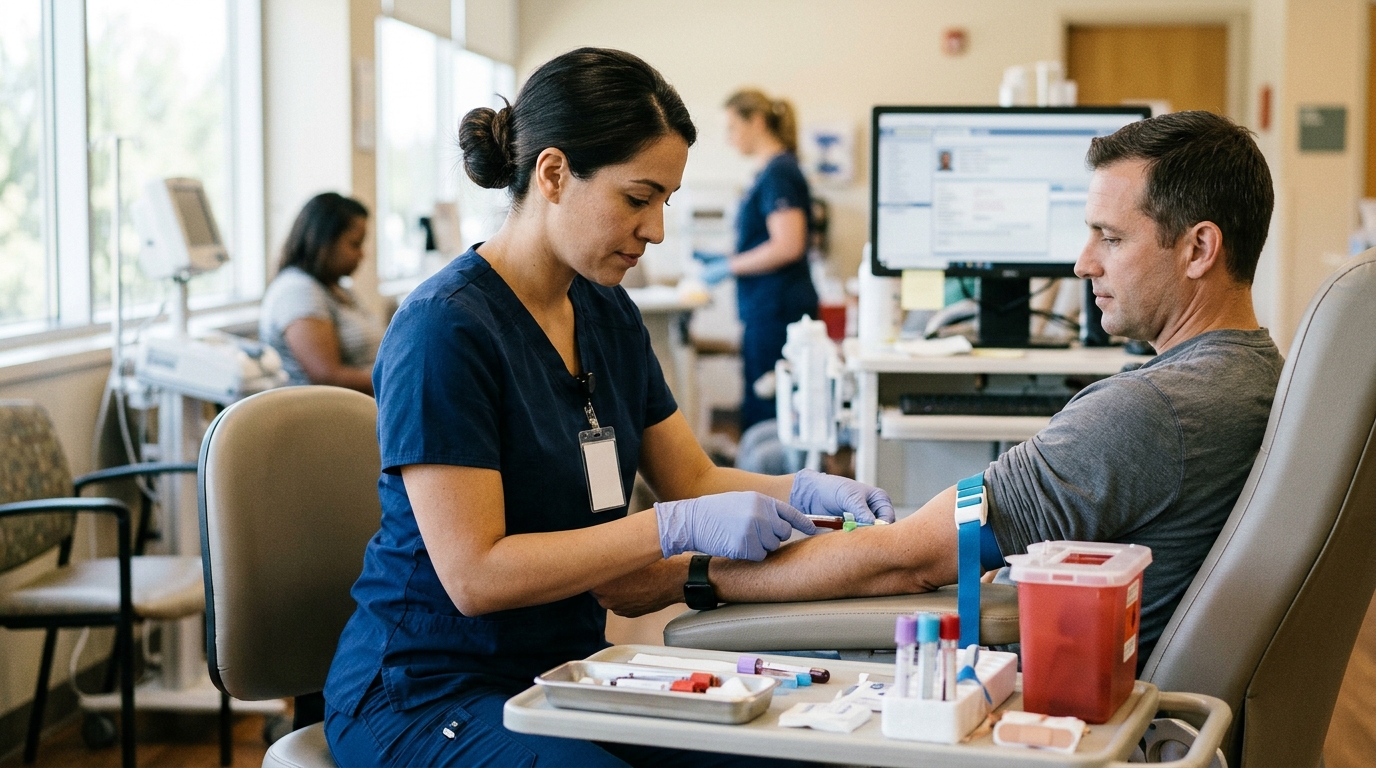
You can enter phlebotomy without a college degree. The typical entry-level education is a postsecondary nondegree award, and many employers look for candidates who have completed a professional certification (U.S. Bureau of Labor Statistics, 2025); certificate programs run at community colleges, vocational schools and technical schools and usually take less than one year (U.S. Bureau of Labor Statistics, 2025).
What replaces the degree is specific and checkable: a completed training program, a logged number of successful live venipunctures, a passed certification exam such as the NHA CPT or PBT(ASCP), and — in four states — a state license.
What Employers Accept Instead of a Degree
No four-year degree is expected here. CareerOneStop (U.S. Department of Labor) lists people starting in this career as usually holding a postsecondary certificate, with no prior work experience and no on-the-job training required. The substitutes employers actually look at are these:
A completed phlebotomy certificate program. Offered by community colleges, vocational schools and technical schools, usually finishing in under 1 year (U.S. Bureau of Labor Statistics, 2025). Hospital and reference-laboratory hiring managers generally want to see the program named on your resume along with the clinical component, because it is the evidence you have drawn blood from live patients rather than a practice arm.
A national certification. Many employers look for phlebotomists who have completed some kind of professional certification (U.S. Bureau of Labor Statistics, 2025). The main credentials are the Certified Phlebotomy Technician (CPT) from the National Healthcareer Association, the Phlebotomy Technician PBT(ASCP) from the American Society for Clinical Pathology, the National Certified Phlebotomy Technician (NCPT) from the National Center for Competency Testing, the Registered Phlebotomy Technician (RPT) from American Medical Technologists, and the Phlebotomy Technician Certificate (PTC) from the American Society of Phlebotomy Technicians. Hospital labs and accredited diagnostic laboratories lean toward PBT(ASCP), which requires a NAACLS-accredited program; outpatient clinics, physician offices and staffing agencies commonly accept NHA, NCCT or AMT credentials. Ask the specific employer which it recognizes before you choose your exam.
Documented work experience in place of a program. ASCP accepts a high school diploma plus one year of full-time clinical experience as a phlebotomy technician in an accredited laboratory within the last five years. The ASPT PTC accepts 6 months full-time or 1 year part-time work experience. NHA also publishes a work-experience alternative to its training requirement. These routes suit people already working as lab assistants or donor-center staff.
A registered apprenticeship. NCCT's High School and Graduate pathways include U.S. Department of Labor Registered Apprenticeship programs as a qualifying route to exam eligibility.
A state license. As of 2024, California, Louisiana, Nevada and Washington require licensure. California introduced it in 2001 after an on-the-job-trained phlebotomist was found re-using needles, and the state's CPT I credential is overseen by the California Department of Public Health's Laboratory Field Services program. In those states the license, not the certificate, is the thing that legally lets you work.
Military and federal training. The Department of Defense Credentialing Opportunities On-Line (COOL) tool lists PBT(ASCP) as a credential service members can pursue, with minimum eligibility of a high school diploma or GED plus a NAACLS-approved phlebotomy program completed within the last five years or another listed route, a written exam and a required fee.
Where you will be working matters too: phlebotomists are employed in hospitals, medical and diagnostic laboratories, blood donor centers and doctors' offices (U.S. Bureau of Labor Statistics), and donor centers often run their own structured training for new staff.
Compare Your Fastest Entry Options
Fees change, so treat the certifying body's published fee page as the live source. The measurable differences that actually separate these paths are clinical hours and the number of documented sticks each one demands.
| Path | Typical duration | Cost to check | Measurable requirement | Best fit |
|---|---|---|---|---|
| Community college or vocational phlebotomy certificate, then NHA CPT exam | Less than 1 year (U.S. Bureau of Labor Statistics, 2025); accelerated formats are shorter | Tuition from the school's current catalog; exam fee from NHA; recertification every 2 years costs $179 | Training completed within 5 years of the exam, including 30 venipunctures and 10 capillary/finger sticks on live individuals | The shortest documented-stick requirement of the major routes |
| NAACLS-accredited program, then PBT(ASCP) Route 1 | Longer, because of the clinical load | Program tuition plus the ASCP exam fee listed on its site | 100 clock hours of clinical training and at least 100 successful independent venipunctures, program completed within the last 5 years | Hospital and accredited-laboratory hiring, and the route listed on DOD COOL |
| Accredited program, then AMT RPT exam | Set by the program's didactic schedule | Tuition plus AMT's published exam fee | At least 120 didactic hours, 50 venipunctures and 10 skin punctures; 200-question exam | Candidates who want a classroom-heavy program |
| U.S. Department of Labor Registered Apprenticeship, then NCCT NCPT exam | Set by the apprenticeship sponsor | NCCT publishes its NCPT exam fee; apprenticeships are employer-sponsored | Completion of the registered apprenticeship as a qualifying NCCT pathway | Earning while training; NCCT advises checking state guidelines in California and Louisiana |
| Work-experience route (ASCP or ASPT) | 6 months to 1 year of employment | Exam fee only, from the certifying body | ASCP: 1 year full-time clinical experience in an accredited lab within 5 years. ASPT: 6 months full-time or 1 year part-time | People already employed in a lab or donor center |
| California CPT I via CDPH Laboratory Field Services | Driven by the 80 training hours plus state processing | State application fee plus approved program tuition | 40 hours classroom and 40 hours practical training, including at least 50 venipunctures, 10 skin punctures and observation of arterial punctures, plus an approved certification exam | Mandatory if you intend to work in California |
No program can guarantee a job. Ask any school, in writing, for its certification exam pass rate and its graduate employment figures before you enroll, and ask whether the clinical placement is arranged for you or whether you must find your own — an unplaced clinical is the most common reason a short program stretches by months.
Step-by-Step: Fastest Path to a First Job
Realistic minimum from enrollment to applying: 10-20 weeks on an accelerated certificate plus exam. Add state processing time in licensure states.
- Confirm your high school diploma or GED (week 1). NHA CPT eligibility requires a high school diploma or equivalent, as does PBT(ASCP) Route 1. Order an official copy now; programs ask for it at enrollment.
- Check your state rule before you pay anything (week 1). Varies by state. As of 2024, California, Louisiana, Nevada and Washington require licensure. NCCT specifically advises candidates to check state guidelines in California and Louisiana. Contact your state health department or laboratory licensing board and confirm which programs and exams it approves.
- Pick the credential first, then the program (week 1-2). If you want PBT(ASCP) Route 1, the program must be NAACLS-accredited and deliver 100 clock hours of clinical training. If you want NHA CPT, the program must include 30 venipunctures and 10 capillary sticks. Choosing the exam afterward is how people end up ineligible.
- Enroll and get the tuition figure in writing (week 2). Request the full cost including textbooks, scrubs, background check, immunization records and the exam voucher if it is bundled.
- Complete didactic and clinical hours (weeks 2-14, varies by program). In California the state pathway is 40 hours classroom and 40 hours practical.
- Log every stick with a signed competency record (throughout). Your instructor or clinical supervisor signs off counts: 30 venipunctures and 10 capillary sticks for NHA, 50 venipunctures and 10 skin punctures under AMT's 120 didactic hours, at least 100 venipunctures for PBT(ASCP), 75 venipunctures and 5 fingersticks for the ASPT PTC, and 50 venipunctures plus 10 skin punctures for California CPT I.
- Register and sit the exam within the deadline (weeks 12-18). NHA requires you to test within 6 months of completing training and registering with a testing center. The NHA CPT exam has 120 questions (100 scored, 20 unscored), a 2-hour limit and a passing scaled score of 390 on a 200-500 range. If you fail, you can retake after a 30-day wait, with 3 attempts before a 1-year wait. Pay the current fee listed by the certifying body.
- Apply for your state license if required (weeks 14-20). Varies by state. California CPT I applications go through CDPH Laboratory Field Services; build in processing time.
- Apply to the four main employer types (week 16 onward). Hospitals, medical and diagnostic laboratories, blood donor centers and doctors' offices (U.S. Bureau of Labor Statistics). Employment is projected to grow much faster than average from 2025 to 2035 (U.S. Bureau of Labor Statistics, 2025).
- Diary your renewal. NHA recertification is every two years for $179.
What You'll Still Need to Prove
Every item below is either in your file or it is not. Have scans of all of them before you apply.
- High school diploma or GED certificate, in a form the certifying body and employer will accept.
- Certificate of completion from your phlebotomy program, showing the completion date — NHA requires training completed within 5 years of the exam, and ASCP Route 1 within the last five years.
- A signed clinical competency log with the exact counts: 30 venipunctures and 10 capillary sticks (NHA), 50 venipunctures and 10 skin punctures (AMT RPT, and California CPT I), 75 venipunctures and 5 fingersticks (ASPT PTC), or at least 100 independent venipunctures (PBT(ASCP) Route 1).
- Your certification number and issue date — CPT (NHA), PBT(ASCP), NCPT (NCCT), RPT (AMT) or PTC (ASPT) — plus the next renewal date.
- Your state license number if you work in California, Louisiana, Nevada or Washington, as of 2024. Verify current status on your state board's lookup before every application.
- Proof of a passed exam score where the employer asks for it; the NHA CPT passing scaled score is 390.
- Documented work experience if you used an alternate route: 1 year full-time in an accredited lab (ASCP), or 6 months full-time / 1 year part-time (ASPT), with employer dates and supervisor contact.
- Two or three clinical references, named, with current phone and email — your clinical preceptor carries more weight than a classroom instructor.
- Immunization records and TB screening, a background check, and a current BLS/CPR card where the employer or clinical site requires it.
- A valid government ID matching the name on your certification, which testing centers check at the door.
Frequently asked questions
What is the shortest realistic time from zero to certified?
Phlebotomy certificate programs usually take less than 1 year (U.S. Bureau of Labor Statistics, 2025), and accelerated formats plus testing commonly run 10-20 weeks. The binding deadlines are NHA's: training must be completed within 5 years of the exam, and you must test within 6 months of completing training and registering with a testing center.
Can I qualify for a certification exam without attending a program?
On some routes. ASCP accepts a high school diploma plus 1 year of full-time clinical experience as a phlebotomy technician in an accredited laboratory within the last five years. The ASPT Phlebotomy Technician Certificate accepts 6 months full-time or 1 year part-time work experience. NCCT's pathways also recognize U.S. Department of Labor Registered Apprenticeship programs.
Does entering without a degree limit my pay or advancement?
The occupation itself is a nondegree one, so you are not starting behind degree-holders. Within phlebotomy, pay spreads: in May 2025 the lowest 10 percent earned less than $35,780 and the highest 10 percent more than $58,780 (U.S. Bureau of Labor Statistics). Moving into laboratory testing roles generally requires separate schooling — ask the certifying body what its next credential demands.
What happens if I fail the NHA CPT exam?
You can retake it after a 30-day waiting period, and you may take it 3 times before waiting 1 year to test again. The exam has 120 questions (100 scored, 20 unscored), a 2-hour limit, and a passing scaled score of 390 on a 200-500 scale. Each attempt carries the current NHA fee.
Do I need a state license as well as certification?
In four states, yes. As of 2024, California, Louisiana, Nevada and Washington require phlebotomy licensure. California's CPT I requires 40 hours of classroom and 40 hours of practical training, including at least 50 venipunctures and 10 skin punctures plus observation of arterial punctures, through the Department of Public Health's Laboratory Field Services. Check your own state board directly.
Sources
- U.S. Bureau of Labor Statistics — Phlebotomists : Occupational Outlook Handbook (2025)
- U.S. Bureau of Labor Statistics (via career-technical-education rack card reproducing OOH content) — If you want a career caring for others, a career in Healthcare may be right for you