Career Growth & Skills
Career Growth & Skills guides on Careertrailmap.

Digital Marketing Certification Guide: What You Need to Know
Most digital marketing certifications are short, self-paced exams run by the platforms themselves — Google, Meta, HubSpot, Microsoft — plus a smaller set of vendor-neutral credentials from bodies like OMCP and the American Marketing Association. They prove you know how a specific tool works; they do not prove you can grow an account, and hiring managers read them that way.
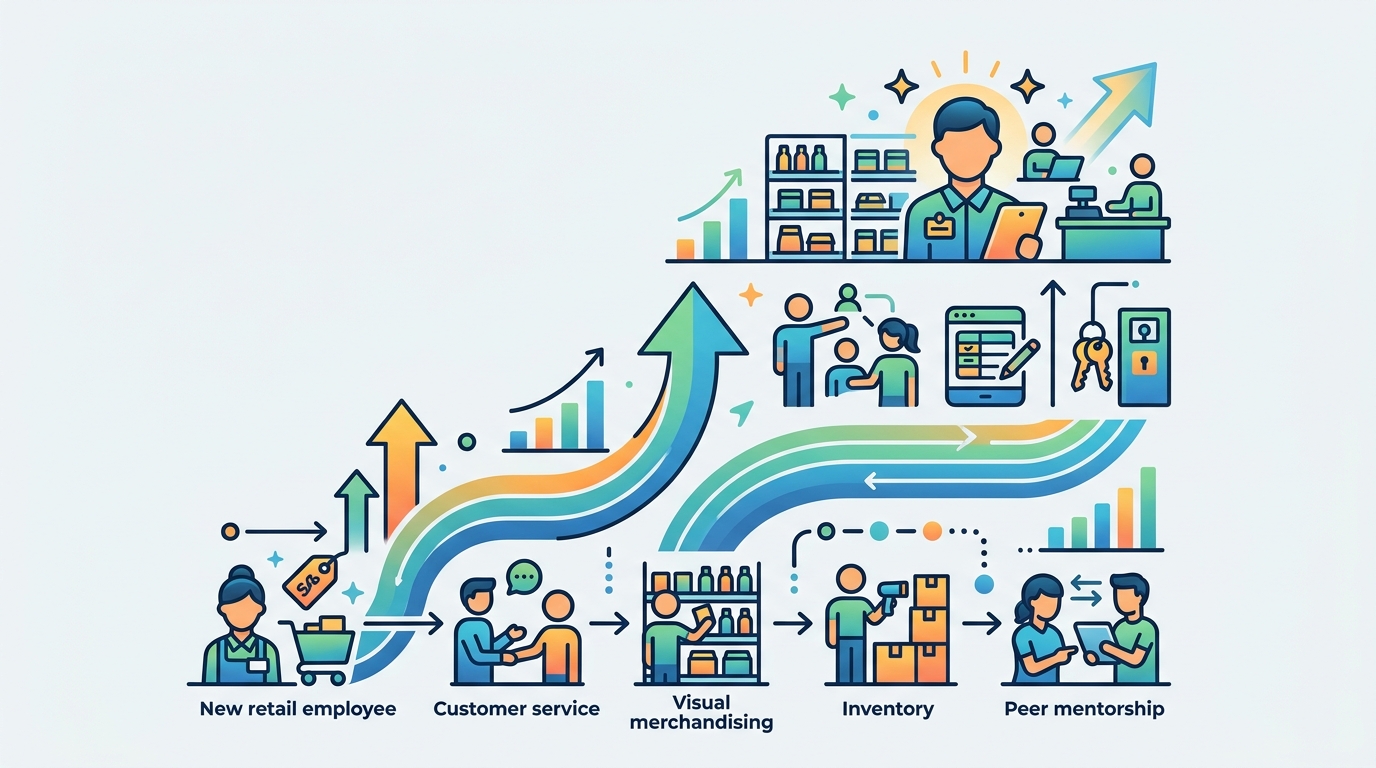
How to Get Promoted to Supervisor in Retail
Getting promoted to supervisor in retail is usually an internal move, not a job search. Employers commonly want 6 months to 2 years of associate experience before promoting someone to supervisor, according to the career guide jobdescription.org, and the typical entry-level education for first-line supervisors of retail sales workers is a high school diploma or equivalent with less than 5 years of related work experience (U.S. Bureau of Labor Statistics, 2025).

How to Learn Excel for Your Career
Learning Excel for work means learning a specific set of jobs the software does: cleaning messy exports, joining two lists together, summarising thousands of rows, and building a report someone else can read without asking you questions. Most people can reach useful working competence in three to six months of steady practice, and you can prove it with a certification exam, a portfolio workbook, or both.

Build Leadership Skills: A Step-by-Step Roadmap
Leadership is learned on the job, in small increments, long before anyone gives you a title. The fastest route is to take charge of something narrow and real — a release, a hiring loop, a weekly standup — then build structured practice and a recognised credential around it.

Is a Career in Logistics and Supply Chain Right for You?
Logistics and supply chain work suits you if you like solving concrete problems against a clock: a container stuck at port, a plant that runs out of a component on Thursday, a carrier invoice that does not match the rate agreement. The U.S. Bureau of Labor Statistics projects 17% employment growth for logisticians from 2024 to 2034 — nearly five times faster than the average for all occupations (reported by Scope Recruiting) — and the typical entry-level education for the occupation is a bachelor's degree (U.S. Bureau of Labor Statistics, 2025).

How to Switch from Administrative Assistant to Office Manager
Moving from administrative assistant to office manager is usually an internal promotion rather than a career restart: you keep the calendar, vendor and systems knowledge you already have, and add budget ownership, supplier contracts and responsibility for other people's work. The U.S. Bureau of Labor Statistics (2025) classifies most office manager roles under administrative services and facilities managers, which typically calls for a bachelor's degree, often in business or a related field, though some people enter with a high school diploma (U.S. Bureau of Labor Statistics, 2025).

What Does an Office Manager Actually Do Day to Day?
An office manager keeps the administrative machinery of a workplace running: assigning and scheduling support staff, handling supplies and vendors, maintaining records and systems, and checking that the premises are safe and stocked. The day is a mix of interruption-driven requests and recurring administrative cycles — payroll inputs, invoice approvals, onboarding, renewals.

Build Public Speaking Skills: A Step-by-Step Roadmap
Public speaking is a trainable skill, not a personality trait. Over roughly six to twelve months of structured reps — recorded practice, a club that gives you a live audience every week, and one or two real talks with something at stake — you can go from avoiding presentations to volunteering for them.

Is a Career in Human Resources Right for You?
Human resources suits you if you like structure, people problems and paperwork in equal measure. The day-to-day is concrete work — screening applicants, running orientation, fixing a benefits enrollment error, keeping employment records clean — not abstract "people strategy," at least for the first several years. The usual entry point is a bachelor's degree in HR, business or communications (U.S. Bureau of Labor Statistics, 2025), and the field is large: about 939,700 human resources specialists were employed in 2025 (U.S. Bureau of Labor Statistics, 2025).