How to Get Promoted to Supervisor in Retail
What store leadership actually weighs when a keyholder slot opens: the duties, the credentials, and the internal application steps that decide it.
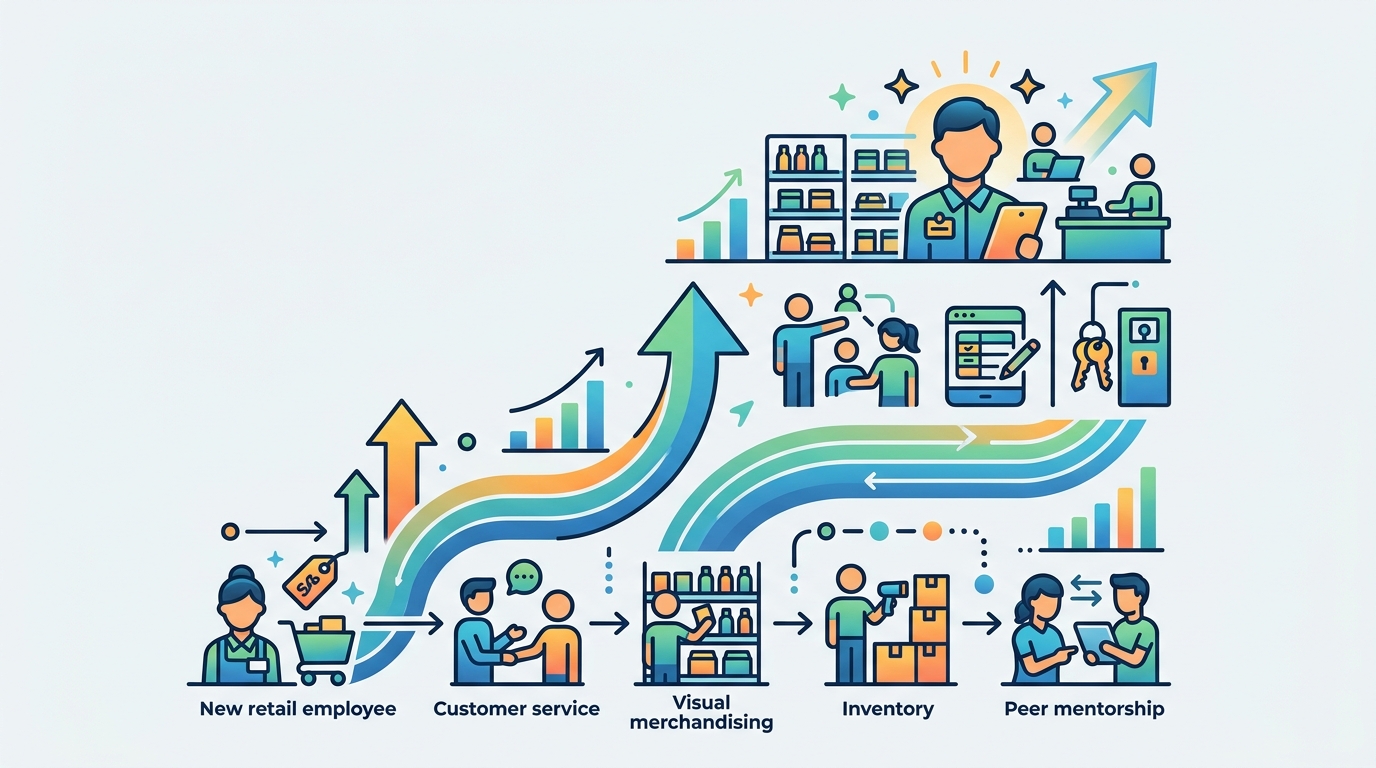
Getting promoted to supervisor in retail is usually an internal move, not a job search. Employers commonly want 6 months to 2 years of associate experience before promoting someone to supervisor, according to the career guide jobdescription.org, and the typical entry-level education for first-line supervisors of retail sales workers is a high school diploma or equivalent with less than 5 years of related work experience (U.S. Bureau of Labor Statistics, 2025).
The gap is rarely academic. It is proving you can build a schedule, train new hires, run cash and shrink controls, and read a daily sales report — before anyone has given you the title.
Old Path vs New Path Compared
The jump from the sales floor to the supervisor's office changes your pay structure, your hours, and the kind of pressure you carry home.
| Attribute | Retail sales associate | First-line supervisor of retail sales workers |
|---|---|---|
| Median annual pay | $35,560 per year in 2025 (U.S. Bureau of Labor Statistics, 2025) | $48,520 in May 2025 (U.S. Bureau of Labor Statistics, 2025) |
| Typical entry education | No formal educational credential typically needed (U.S. Bureau of Labor Statistics, 2025) | High school diploma or equivalent, with less than 5 years of related work experience and no on-the-job training typically required (U.S. Bureau of Labor Statistics, 2025) |
| Weekly hours | Mostly full time, with schedules that may require evening and weekend work (U.S. Bureau of Labor Statistics, 2025) | Typically full time, and the majority of supervisors work more than 40 hours a week (CareerOneStop, U.S. Department of Labor, undated) |
| Day-to-day work | Selling, stocking, running the point-of-sale system, handling returns, working in clean, well-lit stores (U.S. Bureau of Labor Statistics, 2025) | Scheduling, monitoring sales activity, training staff, preparing operational budgets, plus purchasing, accounting and personnel work (O*NET OnLine, U.S. Department of Labor, undated) |
| Outlook, 2025-2035 | Little or no change in employment, with about 550,600 openings projected each year on average, mostly from replacement needs (U.S. Bureau of Labor Statistics, 2025) | Projected to decline 4 percent, a loss of 52,500 jobs (U.S. Bureau of Labor Statistics, 2025) |
Two things follow from that table. First, the pay gain is real but it is attached to longer weeks, so compare the two roles on effective hourly earnings, not headline pay. Second, supervisor roles are getting scarcer overall, which means you should treat an opening at your own store as something to compete for rather than wait for. How supervisor pay is actually structured — hourly with overtime, salaried, or salaried with a monthly or quarterly bonus tied to store sales, shrink or labor targets — varies by employer and by state overtime rules, so ask your HR team exactly which applies before you accept.
Step-by-Step Transition Plan
- Pull up your employer's internal supervisor job description and score yourself against it (Weeks 1-2). Most chains post requirements line by line — keyholder experience, availability windows, cash-handling certification, minimum tenure. Write down every line you cannot yet answer yes to.
- Ask your store manager for keyholder and opening/closing shifts (Months 1-3). This is the single clearest signal of readiness: you are trusted with the alarm code, the safe, the morning cash count and the closing deposit. Say plainly that you are preparing for a supervisor application.
- Earn an industry-recognized retail credential (1-3 months of part-time study). The NRF Foundation's RISE Up program offers three sequential credentials: Retail Industry Fundamentals at entry level, Customer Service & Sales at intermediate, and Business of Retail, the advanced credential aimed at learners progressing in their careers (NRF Foundation, undated). If you are newer to retail, Retail Industry Fundamentals is the introductory course for workplace readiness skills (NRF Foundation, undated).
- Learn the labor and sales numbers (Months 2-4). Ask to sit with your manager while next week's schedule is built against the labor budget, and ask to read the daily sales report, conversion and units-per-transaction figures for your department. Supervisors are expected to handle scheduling, monitoring sales activity and preparing operational budgets (O*NET OnLine, U.S. Department of Labor, undated).
- Own the training of two new hires and document it (Months 3-6). Write the onboarding checklist, run their first week, and keep a short record of what they could do by day five. That record becomes evidence in your interview.
- Apply through your employer's internal job posting or talent portal the day a role is posted (same week). Internal applications usually route to HR and to the hiring store manager, so tell your own manager first and ask them to act as a reference. Expect two to six weeks from application to decision.
- Widen the search if no opening appears within six months (Months 6-12). Supervisor-tier turnover in retail is often 25-40 percent annually, which creates ongoing promotion opportunities for strong associates (jobdescription.org, undated) — but that churn may be at a different store, a different banner or a different format than yours.
- Consider a postsecondary program only if you want to move employers or into multi-unit work (6-24 months). CareerOneStop lists Consumer Merchandising/Retailing Management, Retail Management, Retailing and Retail Operations, and Selling Skills and Sales Operations as programs that can prepare a person for this role (CareerOneStop, U.S. Department of Labor, undated).
Skills and Experience You'll Need to Bridge
- Labor scheduling against a budget. Associates read the schedule; supervisors build it around forecast sales and a fixed labor allowance. Close it by asking to draft one week's schedule under review, then by taking the Business of Retail credential from the NRF Foundation's RISE Up program, the advanced credential aimed at learners progressing in their careers (NRF Foundation, undated).
- Training and coaching other people. Close it with a stretch assignment: ask to own onboarding for the next seasonal intake, including the first-day store tour, point-of-sale training and the week-one competency checklist. Training staff is a named duty of the role (O*NET OnLine, U.S. Department of Labor, undated).
- Cash control and shrink. Volunteer for cycle counts, safe counts, the end-of-day deposit and the cash-office audit. Ask loss prevention to walk you through how your store investigates a shrink variance.
- Reading operational numbers. Supervisors handle budgeting and accounting tasks alongside supervision (O*NET OnLine, U.S. Department of Labor, undated). Build a simple spreadsheet tracking your department's weekly sales against last year and against plan, and bring it to your check-ins.
- Difficult conversations. Ask to sit in as a witness on coaching conversations and attendance discussions, and ask your manager to walk you through how your employer documents performance. De-escalating an angry customer at the returns counter is the version you already do; the new version is holding a peer to a standard.
- Merchandising execution. Take ownership of one department's planogram resets, markdowns and signage for a full quarter so you can point to a before-and-after result.
- A formal credential, if you are switching employers. Programs such as Retail Management or Retailing and Retail Operations are listed as preparation for this role (CareerOneStop, U.S. Department of Labor, undated), and they help most when you have no internal track record to show.
Sample Pitch: Explaining the Switch
Use this when you ask your manager to back you, or in an interview for a supervisor opening at another store. Keep it to evidence you can name.
Asking your manager to support your supervisor application
What to say in a one-to-one, before a role is posted
I want to be considered for the next supervisor opening here, and I'd like your honest read on what's missing. Over the last six months I've been closing two nights a week, running the deposit, and I trained both of our seasonal hires — they were both on the register solo by day four. I've also started working through the NRF Foundation's RISE Up Business of Retail credential, mostly because I want to understand the labor budget side rather than just working to the schedule. What I haven't done yet is build a schedule or handle a coaching conversation, so if you can let me draft next week's schedule under your review, I'll have that covered. If a role opens at another store in the district instead, I'd like you to tell me early so I can apply.
Adapt the specifics. If you have not trained anyone yet, swap in shrink or merchandising results. Do not claim a credential you have not finished — name where you are in it.
Timeline: What to Expect
- Months 1-3: eligibility and visibility. You are picking up keyholder and opening/closing shifts and have told your manager, in writing, that you want the next supervisor opening. Many employers require 6 months to 2 years of retail associate experience before promoting someone to supervisor (jobdescription.org, undated), so check your tenure against that floor early.
- Months 3-6: credential and evidence. You finish a RISE Up credential, have trained at least two new hires, and can talk through your department's sales numbers without notes. This is the earliest point most internal applications become credible.
- Months 6-12: applications. You apply through your employer's internal posting system each time a role appears, in your store and across the district. Expect two to six weeks per process and expect to be passed over at least once; supervisor-tier turnover of 25-40 percent annually keeps openings coming (jobdescription.org, undated).
- Months 12-36: the move, or a wider search. Many individuals move from retail associate into a supervisor role within 1-3 years of starting in retail, often by taking on extra responsibilities and seeking internal training or mentorship (Himalayas, undated). If you are past 18 months with no offer, apply to other employers rather than waiting.
- First 90 days as supervisor: the adjustment. You shift from selling to scheduling, monitoring sales activity, training staff and preparing operational budgets (O*NET OnLine, U.S. Department of Labor, undated), and your hours lengthen — the majority of supervisors work more than 40 hours a week (CareerOneStop, U.S. Department of Labor, undated).
Frequently asked questions
Could my take-home pay actually go down after the promotion?
It can, in practice, if your employer moves you from hourly to salaried and you lose overtime. Retail sales workers had a median of $17.10 per hour in 2025 (U.S. Bureau of Labor Statistics, 2025), and a busy associate picking up extra hours can out-earn a salaried supervisor who works more than 40 hours a week without overtime, which CareerOneStop (U.S. Department of Labor, undated) reports is the majority. Ask HR whether the role is classified as exempt or non-exempt, what the bonus structure pays and how often, and check your state's overtime rules, since they vary.
Do I need a college degree to be a retail supervisor?
No. The typical entry-level education is a high school diploma or equivalent, with less than 5 years of related work experience and no on-the-job training typically required (U.S. Bureau of Labor Statistics, 2025). A postsecondary program such as Retail Management or Consumer Merchandising/Retailing Management (CareerOneStop, U.S. Department of Labor, undated) helps most when you are applying to a new employer with no internal track record.
My store has no supervisor opening. What now?
Keep building the evidence and widen your radius to other stores in your district and to other banners and formats. Supervisor-tier turnover in retail is often 25-40 percent annually (jobdescription.org, undated), so the opening frequently exists somewhere other than your own back room. Tell your manager you are applying across the district rather than quietly leaving — they often have early notice of vacancies.
Is it worth moving into supervision when the occupation is shrinking?
The decline of 4 percent projected from 2025 to 2035 (U.S. Bureau of Labor Statistics, 2025) means fewer roles over time, not none; replacement hiring continues as supervisors leave. The practical response is to make yourself the obvious internal candidate before a vacancy appears and to treat the scheduling, budgeting and personnel skills you build as portable into operations, inventory and multi-unit roles.
Which RISE Up credential should I take first?
If you are new to retail or returning to work, start with Retail Industry Fundamentals, the introductory course covering workplace readiness skills (NRF Foundation, undated). If you already have a year or more on the floor, go straight to Business of Retail, the advanced credential aimed at learners progressing in their careers (NRF Foundation, undated), because it maps closest to the budgeting and operations side of a supervisor's job.
Sources
- U.S. Bureau of Labor Statistics — Data for Occupations Not Covered in Detail (2025)
- U.S. Bureau of Labor Statistics — Retail Sales Workers : Occupational Outlook Handbook (2025)