Veterinary Technician vs Veterinary Assistant: Which One Fits You Better?
Both roles put you in the exam room with animals, but only one needs a degree and a state credential — here is how the daily work actually splits.
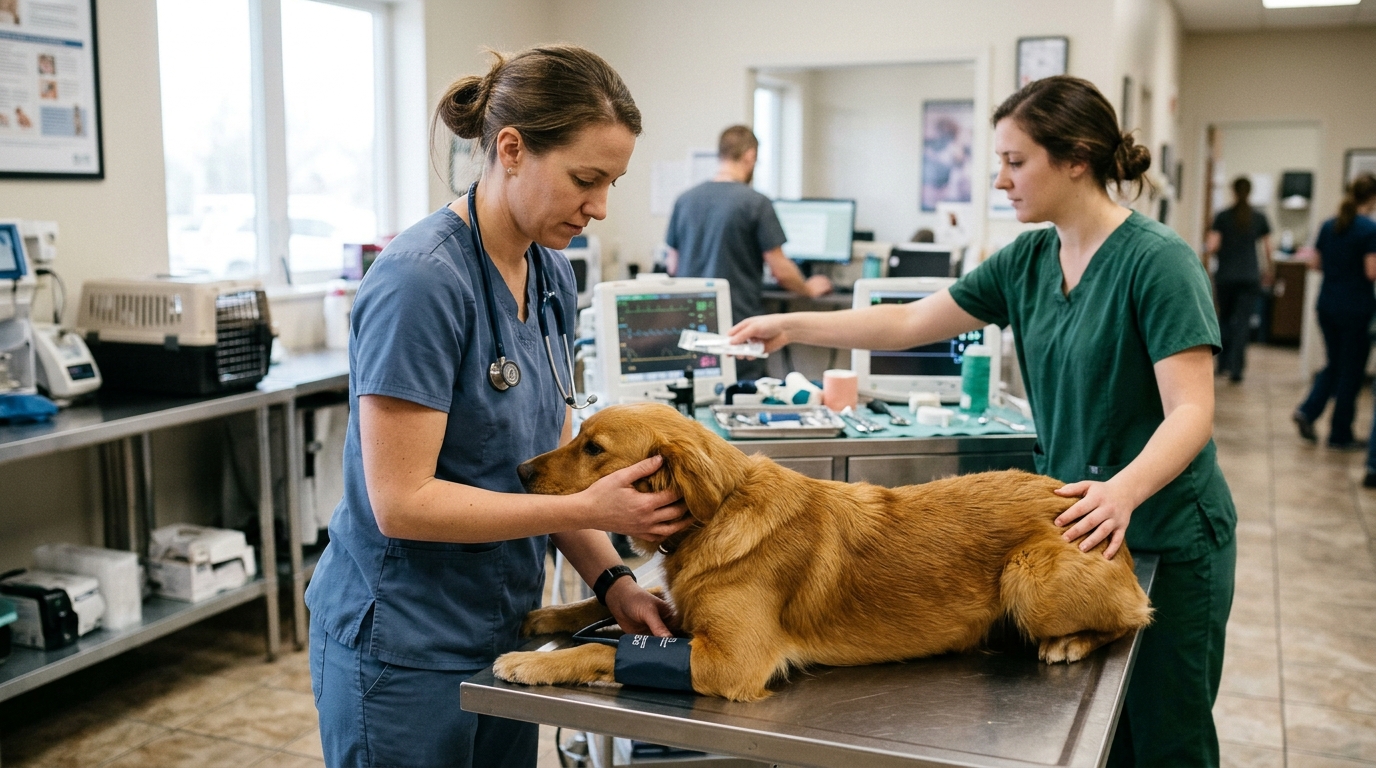
Veterinary technicians and veterinary assistants work side by side in the same clinics, often with the same patients, but the entry route and the scope of work are different. A veterinary technician typically needs an associate's degree and must pass a credentialing exam to be registered, licensed, or certified depending on the state (U.S. Bureau of Labor Statistics, 2025), which opens up anesthesia monitoring, radiographs, and lab work. A veterinary assistant usually starts with a high school diploma and short-term on-the-job training (U.S. Bureau of Labor Statistics, 2025), focusing on husbandry, restraint, sanitation, and post-surgical monitoring.
If you want clinical responsibility and are willing to study for it, look at the technician path. If you want to be working with animals within weeks rather than years, start as an assistant — many people use that job to decide whether the degree is worth it.
Veterinary Technician vs Veterinary Assistant at a Glance
Both occupations are tracked separately by the U.S. Bureau of Labor Statistics, so the figures below come from different occupational profiles: veterinary technologists and technicians, and veterinary assistants and laboratory animal caretakers.
| Metric | Veterinary Technician | Veterinary Assistant |
|---|---|---|
| Typical entry-level education | Associate's degree, usually a 2-year veterinary technology program; technologists usually hold a 4-year bachelor's in veterinary technology (U.S. Bureau of Labor Statistics, 2025) | High school diploma or equivalent, plus short-term on-the-job training (U.S. Bureau of Labor Statistics, 2025) |
| Median pay | $47,380 per year, $22.78 per hour, for veterinary technologists and technicians (U.S. Bureau of Labor Statistics, 2025) | $38,150 per year, $18.34 per hour, for veterinary assistants and laboratory animal caretakers (U.S. Bureau of Labor Statistics, 2025) |
| Typical hours | Usually full time, often including evenings, weekends, or holidays (U.S. Bureau of Labor Statistics, 2025) | Some work part time; nights, weekends, and holidays are common (U.S. Bureau of Labor Statistics, 2025) |
| Physical demands | High: one of the highest rates of injuries and illnesses of all occupations, including bites, scratches, and kicks while restraining animals (U.S. Bureau of Labor Statistics, 2025) | High: lifting, bathing, and exercising animals, restraining patients during exams and lab procedures, and cleaning cages and operating rooms (U.S. Bureau of Labor Statistics, 2025) |
| Entry barrier | Complete an accredited program, then typically pass a credentialing exam and become registered, licensed, or certified depending on the state (U.S. Bureau of Labor Statistics, 2025); the VTNE runs three hours with 170 questions (American Association of Veterinary State Boards, undated) | No mandatory credential; NAVTA's Approved Veterinary Assistant (AVA) exam is optional and demonstrates competency in animal husbandry, health and welfare, and facility administration (U.S. Bureau of Labor Statistics, 2025; NAVTA, undated) |
| Job outlook, 2025-35 | 9%, much faster than average (U.S. Bureau of Labor Statistics, 2025) | 9%, much faster than average (U.S. Bureau of Labor Statistics, 2025) |
| Common first job title | Veterinary technician, or registered/licensed/certified veterinary technician once credentialed in your state | Veterinary assistant, kennel assistant, or laboratory animal caretaker |
Pay varies a lot by state, by practice type, and between general practice, emergency hospitals, and research facilities. Check current figures for your state on the Bureau of Labor Statistics Occupational Outlook Handbook and your state's veterinary board for credentialing rules, because the title you may legally use differs from state to state.
Where These Careers Overlap
On a busy Tuesday morning the two jobs can look identical. Both technicians and assistants restrain animals during exams and procedures — holding a cat in lateral recumbency for a blood draw, or keeping a 90-pound dog steady while the veterinarian palpates an abdomen (U.S. Bureau of Labor Statistics, 2025). Both give medications, immunizations, and vaccines as prescribed, which means reading a treatment sheet correctly, calculating or confirming a dose, and recording what was given.
Both also work around surgery. Technicians prepare animals and instruments for surgery; assistants maintain and sterilize surgical instruments and monitor animals after surgery (U.S. Bureau of Labor Statistics, 2025). Both help provide first aid in an emergency and assist with collecting blood, urine, and tissue samples.
The shared skills are therefore practical: safe animal handling, aseptic technique with autoclaved instrument packs, accurate charting, and the composure to hold a frightened patient still while a client watches. Both roles also carry the same injury exposure from bites, scratches, and kicks (U.S. Bureau of Labor Statistics, 2025).
Where They Diverge
The single biggest practical divergence is credentialed clinical scope. Veterinary technicians typically must pass a credentialing exam and be registered, licensed, or certified depending on the state (U.S. Bureau of Labor Statistics, 2025), and that credential is what lets them take on tasks a clinic cannot hand to an uncredentialed assistant: administering anesthesia and monitoring the animal's response, taking x-rays, and performing laboratory tests (U.S. Bureau of Labor Statistics, 2025). Veterinary assistants are not required to hold a credential at all (U.S. Bureau of Labor Statistics, 2025), and their work centers on husbandry, sanitation, instrument care, and post-operative observation.
A concrete scenario for each:
- Technician: A dog comes in for a dental extraction. You place the IV catheter, induce and maintain anesthesia under the veterinarian's direction, watch heart rate, blood pressure, and capnography through the procedure, shoot dental radiographs, and adjust the vaporizer when blood pressure drops. If something destabilizes, you are the person reading the monitor.
- Assistant: For the same patient you bring the dog from the kennel, help restrain it for premedication, set up and sterilize the dental instrument pack, disinfect the operating room afterward, and sit with the dog in recovery watching for shivering, vomiting, or a slow return to sternal.
The second divergence follows from the first: the technician route costs you roughly two years in an accredited program plus exam preparation before you hold the title, while the assistant route can start with short-term on-the-job training (U.S. Bureau of Labor Statistics, 2025).
Which Path Fits You Better
Work through these. Column A points to veterinary technician, column B to veterinary assistant. Each item maps to one of the metrics in the comparison table.
- Education path. A: you can commit to a 2-year associate's degree in veterinary technology, or a 4-year bachelor's if you want the technologist title (U.S. Bureau of Labor Statistics, 2025). B: you want to start work with a high school diploma and learn on the job.
- Entry barrier. A: sitting a three-hour, 170-question credentialing exam like the VTNE (American Association of Veterinary State Boards, undated) and registering with your state board sounds manageable. B: you would rather take an optional credential later, such as NAVTA's Approved Veterinary Assistant exam (NAVTA, undated).
- Pay structure. A: you want the higher median — $47,380 a year for technologists and technicians in 2025 — and are willing to fund tuition first (U.S. Bureau of Labor Statistics, 2025). B: you want earnings now at the $38,150 median for assistants and caretakers, with no tuition debt (U.S. Bureau of Labor Statistics, 2025).
- Daily tasks: clinical. A: you want to induce and monitor anesthesia, take radiographs, and run in-house lab tests (U.S. Bureau of Labor Statistics, 2025). B: you are content feeding, bathing, exercising, and recovering patients.
- Daily tasks: facility. A: you accept that cleaning is part of the job but not the core of it. B: disinfecting cages, exam rooms, and operating rooms and keeping instrument packs sterile feels like useful, visible work.
- Typical hours. A: full-time schedules with evenings, weekends, and holidays suit you (U.S. Bureau of Labor Statistics, 2025). B: you need part-time or shift flexibility, which is more common among assistants and laboratory animal caretakers (U.S. Bureau of Labor Statistics, 2025).
- Physical demands and risk. A and B both: you are comfortable restraining animals that bite, scratch, and kick in an occupation with one of the highest injury rates recorded (U.S. Bureau of Labor Statistics, 2025). If this is a no, neither column fits.
- Job outlook. A and B both: you are reassured that each occupation is projected to grow 9% from 2025 to 2035 (U.S. Bureau of Labor Statistics, 2025); neither column wins here.
- First job title. A: you want to be hired as a registered, licensed, or certified veterinary technician and be the person the veterinarian delegates anesthesia to. B: you are happy starting as a veterinary assistant, kennel assistant, or laboratory animal caretaker and deciding later.
If you check more boxes in column A, start researching accredited veterinary technology programs and your state board's credentialing requirements. If you check more boxes in column B, apply for assistant openings now and treat the first year as a paid test of whether the degree is worth it to you.
Frequently asked questions
Can a veterinary assistant become a veterinary technician?
Yes, and it is a common route. You still need to complete a veterinary technology program — usually a 2-year associate's degree — and typically pass a credentialing exam to be registered, licensed, or certified in your state (U.S. Bureau of Labor Statistics, 2025). Clinic experience helps, but it does not replace the degree.
Do veterinary assistants need a certification?
No. Certification is not mandatory for veterinary assistants, though it lets you demonstrate competency in animal husbandry, health and welfare, and facility administration (U.S. Bureau of Labor Statistics, 2025). NAVTA owns the Approved Veterinary Assistant exam, and only programs approved by its Approved Veterinary Assistant Committee may use the AVA logo (NAVTA, undated).
What is the difference between a veterinary technologist and a veterinary technician?
Mainly degree length. Veterinary technologists usually hold a 4-year bachelor's degree in veterinary technology, while veterinary technicians usually hold a 2-year associate's degree in a veterinary technology program (U.S. Bureau of Labor Statistics, 2025). The Bureau reports pay and outlook for both together: $47,380 median in 2025 and 9% growth to 2035.
Which role has better job prospects?
Both are projected to grow 9% from 2025 to 2035, much faster than average (U.S. Bureau of Labor Statistics, 2025). The practical difference is scope: a credentialed veterinary technician can take x-rays, run lab tests, and monitor anesthesia, which widens the range of clinics, emergency hospitals, and research facilities that can use you.
Sources
- U.S. Bureau of Labor Statistics — Veterinary Technologists and Technicians : Occupational Outlook Handbook (2025)
- U.S. Bureau of Labor Statistics — Veterinary Assistants and Laboratory Animal Caretakers : Occupational Outlook Handbook (2025)