How to Become a Personal Trainer: A Step-by-Step Guide
What the certification exams actually test, how long study usually takes, and where to check current pay before you spend a dollar on a course.
Becoming a personal trainer usually means three things: a high school diploma or equivalent, a current CPR/AED certification, and passing a nationally accredited certification exam such as the NASM Certified Personal Trainer or ACE Certified Personal Trainer exam. Most people move from zero experience to a first paid role in roughly four to eight months, depending on how fast they study.
The work itself is coaching: demonstrating exercises, watching technique, adjusting programs, and keeping records — often on a schedule that includes early mornings, nights and weekends.
What the Job Involves Day to Day
Your day is built around booked sessions, with admin squeezed between them.
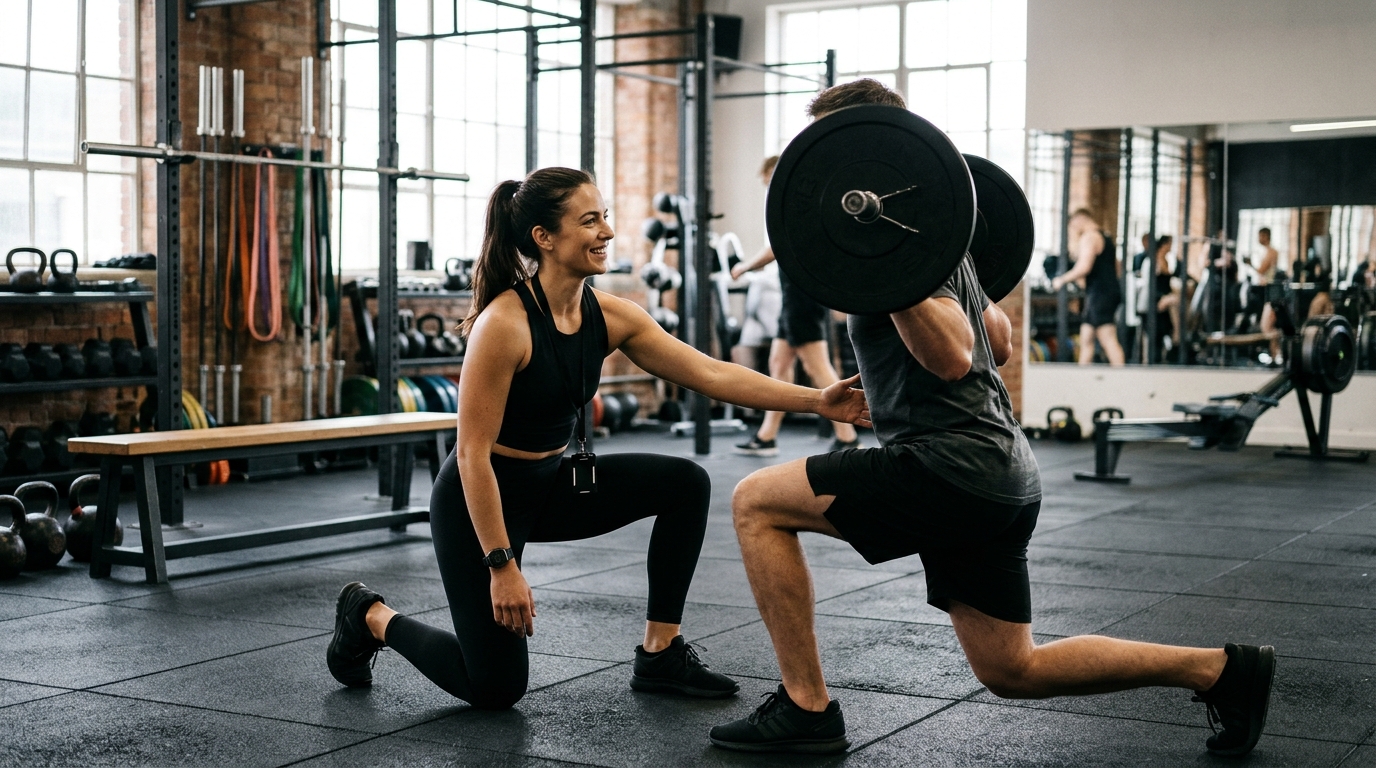
Before a session you review the client's notes and set up equipment — benches, bands, a loaded barbell — so the hour is not spent hunting for plates. During the session you demonstrate and explain each exercise, then watch the client perform it and correct technique as they go (U.S. Bureau of Labor Statistics, undated). You also provide options mid-workout: a client arrives with a sore shoulder, so the overhead press becomes a landmine press at a lower load.
After the session you log what was completed and adapt the program for next time, which is one of the listed duties of fitness trainers and instructors (U.S. Bureau of Labor Statistics, undated). Between clients you may run gym-floor inductions, explain safety rules to new members, and answer questions from people who are not yet your clients.
First aid sits in the background of all of it — trainers are expected to give first aid if needed (U.S. Bureau of Labor Statistics, undated), which is why CPR/AED certification is an exam prerequisite rather than an optional extra.
Across a week, expect variable or part-time hours that can include nights, weekends or holidays, in settings such as recreation centers, health clubs and yoga studios (U.S. Bureau of Labor Statistics, 2024). Early-morning and post-work blocks are the busiest, and the midday gap is when you write programs and reply to clients.
Skills and Traits That Help You Succeed
- Clear demonstration and verbal cueing — you have to show a hip hinge and explain it in two sentences while the client is already holding a dumbbell, because demonstrating and explaining exercises is a core listed duty (U.S. Bureau of Labor Statistics, undated).
- Technique observation — spotting a knee that collapses inward on the fifth rep of a squat and fixing it before rep six. Watching clients for correct technique is part of the job description (U.S. Bureau of Labor Statistics, undated).
- CPR and AED competence (hard skill) — a required credential, not a nice-to-have: NASM requires current CPR/AED certification before you sit the exam, and ACE requires a current certification that includes a live skills check.
- Program design and progress tracking (hard skill) — building and revising training blocks, then recording loads and attendance. ONET lists spreadsheet, presentation, database and client-management software among the software used in this occupation (ONET OnLine, undated), so comfort with a spreadsheet and a booking system matters more than most people expect.
- On-the-spot substitution — providing options during workouts when equipment is taken or a joint is irritated (U.S. Bureau of Labor Statistics, undated). You need a second and third version of every exercise in your head.
- Retention conversations — asking a client at week six whether they want to re-book, and explaining what the next block will cover. Much of your income depends on renewals, not first sessions.
- Schedule tolerance — many trainers work variable or part-time hours including nights, weekends and holidays (U.S. Bureau of Labor Statistics, 2024), so split shifts have to fit your life.
How to Break Into This Career
- Confirm you meet the baseline (week 1). Typical entry-level education is a high school diploma or equivalent (U.S. Bureau of Labor Statistics, 2024). The ACE Certified Personal Trainer exam additionally requires you to be at least 18 and to present government-issued photo ID (American Council on Exercise, undated).
- Get CPR/AED certified (weeks 1–3). NASM requires current CPR and AED certification before you take the exam, though not before you start the course; ACE requires a current certification with a live skills check. Classroom or blended courses usually run a few hours in a single session.
- Choose an NCCA-accredited certification and enroll (month 1). NASM CPT, ACE CPT, NSCA-CPT, NSCA-CSCS, ACSM-CPT, NESTA CPT, AFAA CPT, NCSF CPT and the Cooper Institute CPT hold National Commission for Certifying Agencies accreditation; ISSA's certification is DEAC-accredited rather than NCCA-accredited (Fitcram, undated). Check what your target gyms accept before you pay.
- Study, with the clock running (months 1–6). Both the proctored NASM-CPT exam and the non-proctored NASM Personal Trainer Certificate exam must be taken within 180 days of enrollment (National Academy of Sports Medicine, undated). Three to six months of part-time study is a realistic range.
- Sit and pass the exam (month 4–6). The NASM-CPT NCCA-accredited exam is closed-book and proctored: 120 questions, two hours, scaled passing score of 70 (National Academy of Sports Medicine, undated). The ACE-CPT exam is live-proctored in person or online: 150 multiple-choice questions, three hours, and a score of 500 or more out of 800 to pass (American Council on Exercise, undated).
- Apply for an entry-level floor role (months 5–8). Realistic first titles include Fitness Instructor, Fitness Specialist, Group Fitness Instructor and Personal Trainer (ONET Code Connector, undated). No related work experience is required and training is short-term on the job (U.S. Bureau of Labor Statistics, 2024), so expect to shadow senior trainers while you build a client list — ONET places this occupation in Job Zone Three, where employees usually need one or two years of combined on-the-job experience and informal training with experienced workers (O*NET OnLine, undated).
Typical Timeline From Start to First Job
- Week 1: Confirm eligibility — high school diploma or equivalent, and age 18 or over if you are targeting the ACE-CPT (American Council on Exercise, undated).
- Weeks 1–3: Complete a CPR/AED course, including the live skills check ACE requires.
- Month 1: Enroll with an NCCA-accredited certifying body such as NASM, ACE, NSCA, ACSM or NCSF (Fitcram, undated). The 180-day enrollment window starts here for NASM candidates.
- Months 1–6: Work through the coursework. Most candidates study part-time around an existing job.
- Month 4–6: Sit the exam — 120 questions in two hours for NASM-CPT, or 150 questions in three hours for ACE-CPT.
- Months 5–8: Start an entry-level role such as Fitness Instructor or Fitness Specialist (O*NET Code Connector, undated) and complete short-term on-the-job training (U.S. Bureau of Labor Statistics, 2024) while your session schedule fills.
Years one and two are when the income usually settles, since this occupation typically takes one to two years of on-the-job experience plus informal training with experienced workers (O*NET OnLine, undated).
Salary and Outlook Snapshot
| Measure | Figure | Source and year |
|---|---|---|
| Entry-level (10th percentile) | $27,580 a year / $13.26 an hour | CareerOneStop wage finder, U.S. Department of Labor, 2024 |
| Median pay | $46,180 a year / $22.20 an hour | U.S. Bureau of Labor Statistics Quick Facts, 2024 |
| Median pay (later figure) | $47,160 a year | U.S. Bureau of Labor Statistics, Personal Care and Service Occupations summary, 2025 |
| Experienced (90th percentile) | $82,050 a year / $39.45 an hour | CareerOneStop wage finder, U.S. Department of Labor, 2024 |
| Job growth | 12 percent, 2024–2034, with about 74,200 openings projected each year | U.S. Bureau of Labor Statistics, 2024 |
| Job growth (later projection) | 7 percent, 2025–2035, with about 68,000 openings projected each year | U.S. Bureau of Labor Statistics, undated |
Pay varies sharply by state, metro area and employer type — a recreation center, a health club and a yoga studio (U.S. Bureau of Labor Statistics, 2024) do not pay the same way. Structure matters as much as the headline number: some trainers are hourly employees, some are paid per session with a lower floor-hour rate, and some rent space and keep client fees. Before you commit to a course, look up current wages for your own state and metro on the CareerOneStop wage finder and the BLS Occupational Outlook Handbook entry for fitness trainers and instructors, and ask local gyms how they split session revenue.
Frequently asked questions
Do I need a college degree to be a personal trainer?
No. The typical entry-level education is a high school diploma or equivalent, with no related work experience required and short-term on-the-job training (U.S. Bureau of Labor Statistics, 2024). O*NET places the occupation in Job Zone Three, so one to two years of on-the-job experience and informal training usually follows.
How long do I have to finish my certification once I enroll?
With NASM, both exam options must be taken within 180 days of enrollment (National Academy of Sports Medicine, undated). Most people study part-time for three to six months inside that window. Check your provider's deadline before paying, because the clock starts at enrollment, not at your first study session.
What is the difference between NASM's two exam options?
The NASM-CPT NCCA-accredited exam is closed-book and proctored: 120 questions, two hours, scaled passing score of 70. The Personal Trainer Certificate exam is open-book, online-only, 100 questions, three hours, 70 percent to pass. Gyms often specify NCCA accreditation, so confirm which one your target employers accept.
Does my certification expire?
Yes. The NASM-CPT credential is valid for two years; to renew you must keep current CPR and AED certification and earn 2.0 CEUs, which is 20 hours of continuing education (U.S. Department of Defense, DOD COOL, undated). Budget time and money for recertification from your first year.
Can I start part-time while keeping another job?
Often, yes. Many fitness trainers and instructors work variable or part-time schedules that may include nights, weekends or holidays (U.S. Bureau of Labor Statistics, 2024). Early-morning and evening session blocks are the ones that usually fit around daytime work.
Sources
- U.S. Bureau of Labor Statistics — Fitness Trainers and Instructors : Occupational Outlook Handbook
- U.S. Bureau of Labor Statistics — Fitness Trainers and Instructors : Occupational Outlook Handbook (Quick Facts) (2024)