How to Become a Phlebotomist
Draws, labels, logs: what the work actually looks like, the training route most people take, and the certification steps employers ask about.
Phlebotomists collect blood samples for testing, transfusion, donation or research, then label, log and transport them without breaking the chain of identification. Most people enter after a postsecondary phlebotomy program, which usually takes less than a year (U.S. Bureau of Labor Statistics, 2025), followed by a national certification exam such as the NHA Certified Phlebotomy Technician (CPT) or the ASCP Phlebotomy Technician (PBT).
A few states license phlebotomists directly; most do not, and in those states it is the employer and the certifying body that set the bar. Costs and rules vary by school, state and employer, so check both your state health department and the certifying agency before you enrol.
What the Job Involves Day to Day
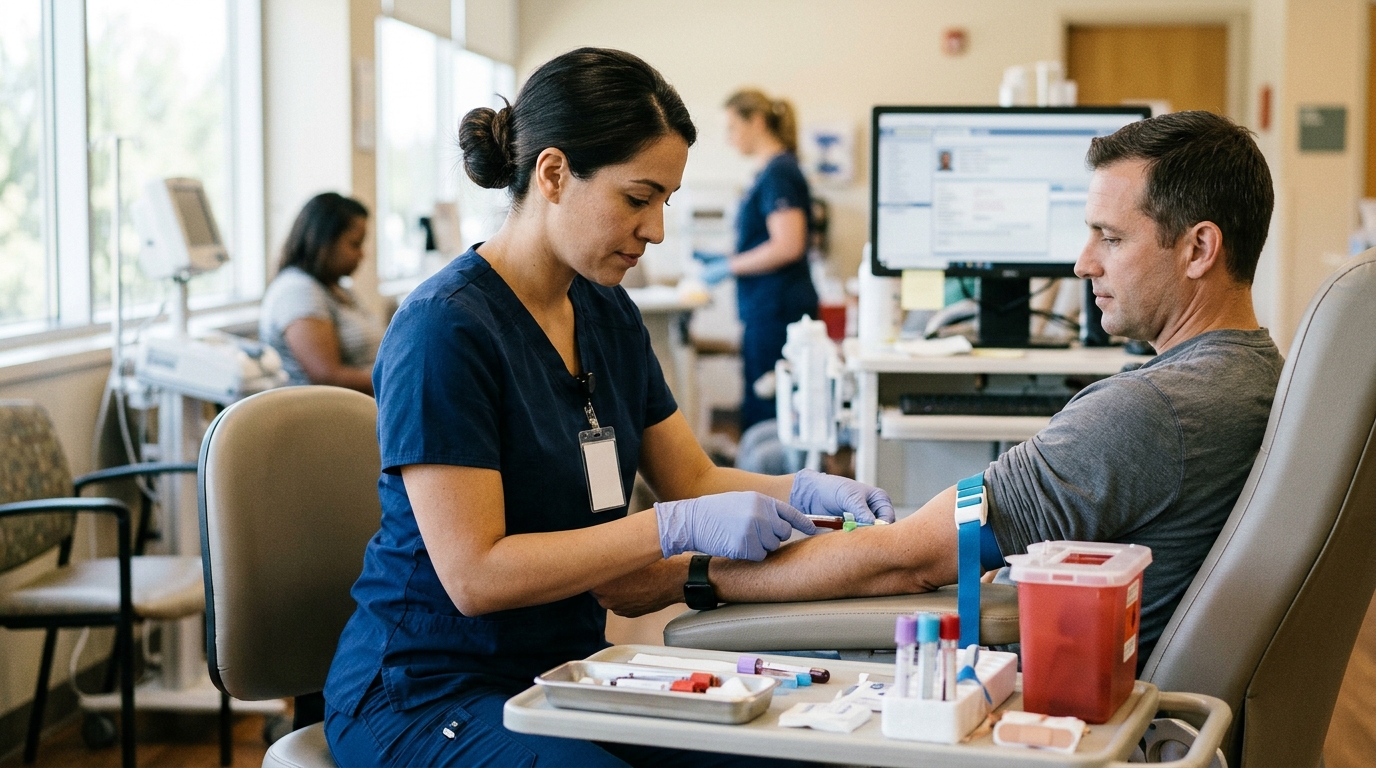
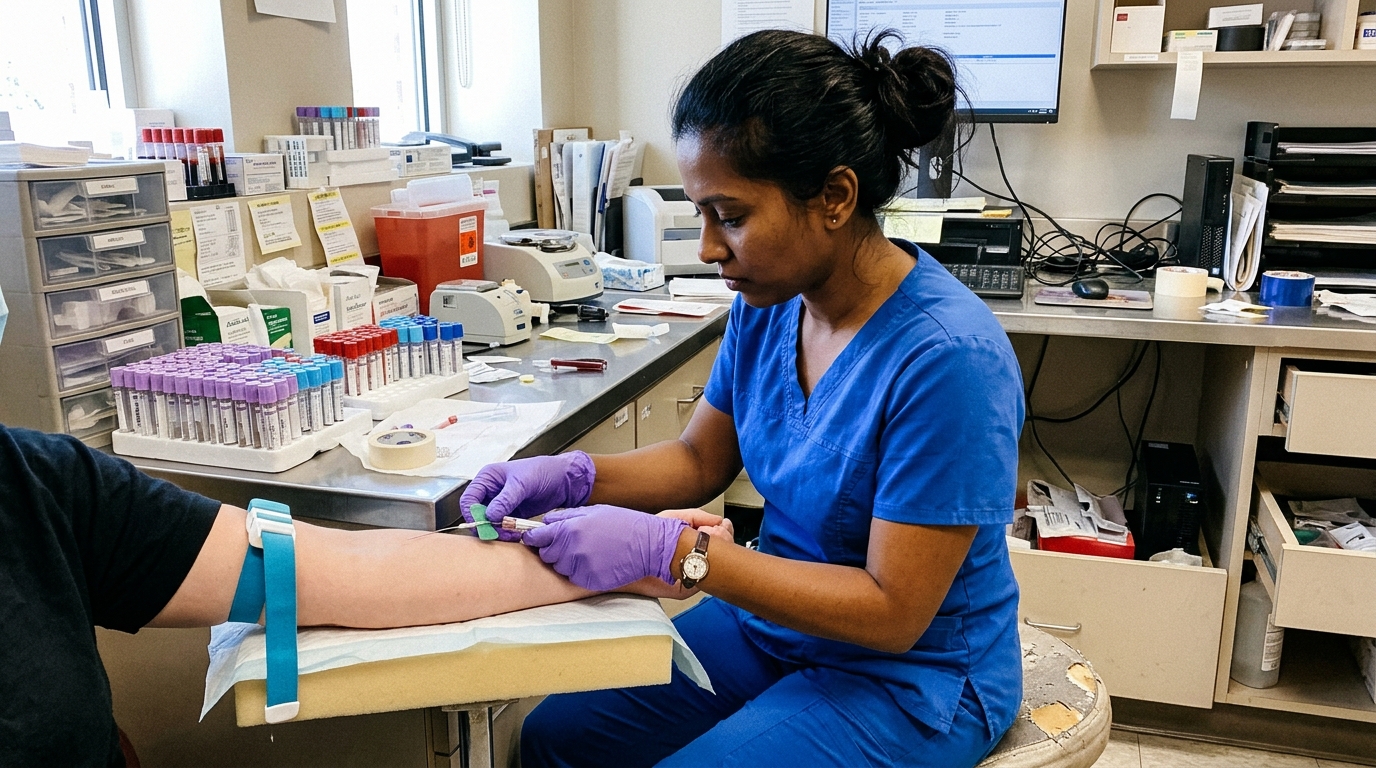
You verify each patient's identity against the test requisition, explain the procedure, apply a tourniquet, palpate for a suitable vein, and draw blood by venipuncture with a straight needle or a winged (butterfly) set — or take a capillary sample with a lancet and microtainer when veins are small or fragile (U.S. Bureau of Labor Statistics; O*NET OnLine, U.S. Department of Labor).
You fill evacuated collection tubes in the correct order of draw, label them at the bedside, scan them into the laboratory information system, and drop sharps straight into the container. Other recurring tasks: centrifuge and aliquot specimens, pack samples for courier transport, restock draw trays and carts, disinfect chairs and tourniquets between patients, and document failed sticks and refusals.
Expect to stand and walk for most of a shift, with early starts in hospitals where morning rounds begin before dawn. You will lift and push supply carts, work in cold specimen storage areas, and in mobile or donor-centre roles drive between collection sites. Fainting, needle-anxious patients and paediatric draws are routine, not exceptions.
Path to Becoming a Phlebotomist
- Finish high school or earn a GED. The typical entry-level education for the occupation is a postsecondary nondegree award built on top of that (U.S. Bureau of Labor Statistics, 2025). Employers generally do not require prior experience in a related occupation (U.S. Bureau of Labor Statistics, 2025).
- Enrol in a postsecondary phlebotomy program. These usually take less than one year (U.S. Bureau of Labor Statistics, 2025) — often one semester of classroom instruction, skills lab and a supervised clinical externship. Tuition varies widely between community colleges, hospitals and private schools; ask for the published total including supplies.
- Log your live sticks. NHA CPT eligibility requires a minimum number of venipunctures and finger sticks performed on live individuals (National Healthcareer Association, 2024). Confirm the current minimums before your externship ends, because retro-fitting hours is difficult.
- Get a current CPR/Basic Life Support card. Most clinical sites require one before you touch a patient; it is typically a half-day to one-day class and is renewed on a fixed cycle.
- Choose a certifying body and check the pathway. NHA offers an education pathway and a work-experience pathway to the CPT (National Healthcareer Association). ASCP's PBT Route 1 runs through completion of an accredited phlebotomy program (American Society for Clinical Pathology).
- Apply for and sit the exam. The NHA CPT is a computer-based, multiple-choice exam with a published fee (National Healthcareer Association, 2024); check the current format and cost on the certifying body's site, as both change.
- Meet state requirements if you work in a licensing state. A small number of states license or certify phlebotomists directly (state licensure listings, 2024). California, for example, issues a Certified Phlebotomy Technician I (CPT I) certificate only after state-approved didactic and practical training hours and a set number of supervised draws (California Department of Public Health). Confirm with your own state health department.
- Apply to hospitals, reference labs, clinics, plasma and blood donor centres. Put your logged venipuncture and finger-stick counts, clinical site and certification number on page one of the resume.
Timeline at a Glance
| Stage | Milestone |
|---|---|
| Before you start | High school diploma or GED in hand; immunisation records, TB test and background check cleared for clinical placement |
| Month 1 | Classroom and skills-lab work begins: anatomy, order of draw, infection control, specimen handling |
| Months 2-4 | Supervised clinical externship; start logging venipunctures and finger sticks on live individuals toward NHA minimums (National Healthcareer Association, 2024) |
| Months 4-9 | Program completion — most postsecondary phlebotomy programs finish in under a year (U.S. Bureau of Labor Statistics, 2025) |
| Within 1 month of finishing | Apply for and sit the NHA CPT or ASCP PBT exam; results for computer-based exams are usually issued quickly |
| Months 6-12 | State certificate where required (for example, California CPT I via the California Department of Public Health); first job applications |
| Year 1 | First paid role, usually with employer orientation and a supervised competency sign-off before independent draws |
| Years 2-3 | Certification renewal with continuing education on the body's published cycle (National Healthcareer Association; American Society for Clinical Pathology) |
Requirements Checklist
- High school diploma or GED certificate obtained.
- Completion certificate from a postsecondary phlebotomy program — typically less than one year of study (U.S. Bureau of Labor Statistics, 2025).
- Documented log of venipunctures and finger sticks on live individuals meeting your certifying body's published minimum (National Healthcareer Association, 2024).
- Current CPR/Basic Life Support card.
- Certification exam application submitted and fee paid — NHA CPT or ASCP PBT (National Healthcareer Association, 2024; American Society for Clinical Pathology).
- Passing exam result and certification number issued.
- State certificate or licence where your state requires one, such as the California CPT I (California Department of Public Health).
- Pre-employment clearances: immunisation records including hepatitis B, TB screening, criminal background check and drug screen.
Education and Cost Comparison
| Route | Typical duration | Cost | Starting pay | Source/year |
|---|---|---|---|---|
| Postsecondary phlebotomy certificate (community college or vocational school) — the most common entry | Less than one year | Published tuition varies by school and state; ask for the all-in figure including supplies and clinical fees | Usually hourly, with shift differentials for nights and weekends; check the median annual pay figure in the BLS Occupational Outlook Handbook | U.S. Bureau of Labor Statistics, 2025 |
| National certification exam on top of the program (NHA CPT or ASCP PBT) | Weeks, once eligibility is met | A single published exam fee; study materials sold separately | No pay of its own, but many employers list certification as a condition of hire | National Healthcareer Association, 2024; American Society for Clinical Pathology |
| State-approved program in a licensing state (for example California CPT I) | Set didactic and practical hours plus a minimum number of supervised draws, usually within the same under-one-year window | Program tuition plus a state certificate fee | Same hourly structure; check BLS state data for your area | California Department of Public Health; U.S. Bureau of Labor Statistics, 2025 |
| Associate degree in clinical laboratory science with phlebotomy skills | About 2 years — roughly 12 or more months longer than the certificate route | Per-credit tuition over four semesters | Opens lab technician roles beyond drawing blood; phlebotomy pay itself is set by employer and region | U.S. Bureau of Labor Statistics, 2025 |
| Employer on-the-job training (donor centres, some hospitals) | Weeks of paid training, varies by employer | Usually no tuition; employer may require certification within a set period | Paid from day one at the employer's own rate | U.S. Bureau of Labor Statistics, 2025 |
Frequently asked questions
How long does it take to become a phlebotomist?
Most postsecondary phlebotomy programs run less than one year (U.S. Bureau of Labor Statistics, 2025), and many finish in a single semester of classroom work plus a clinical externship. Add a few weeks after that to apply for and sit a certification exam. If you take an associate degree route instead, plan on roughly two years — about 12 months longer.
Do I need a licence, or is certification enough?
In most states there is no separate phlebotomy licence, and employers rely on a national certification such as the NHA CPT or ASCP PBT. A small number of states license or certify phlebotomists directly (state licensure listings, 2024); California, for instance, issues a CPT I certificate only after state-approved training hours and supervised draws (California Department of Public Health). Confirm with your state health department before paying for any program.
Which certification should I take, NHA or ASCP?
Both are widely recognised, so check job postings in your area and ask local labs which they list. The NHA Certified Phlebotomy Technician exam is computer-based and multiple choice, and eligibility runs through either an education pathway or a work-experience pathway (National Healthcareer Association, 2024). ASCP's Phlebotomy Technician Route 1 requires completion of an accredited phlebotomy program (American Society for Clinical Pathology). Both require periodic renewal with continuing education.
What determines how much phlebotomists are paid?
Pay is normally hourly, with differentials for nights, weekends and on-call or mobile draw work, and it varies by employer, state and setting — hospital, reference lab, clinic or donor centre. The U.S. Bureau of Labor Statistics publishes a median annual figure and state-by-state data in the Occupational Outlook Handbook (2025); look that up rather than relying on job-board averages. Certification and prior experience are the two things employers most often use to set a starting rate.
Can I get hired without clinical experience?
Your program's externship counts as experience, which is why logging venipunctures and finger sticks on live individuals matters — the NHA sets a published minimum for exam eligibility (National Healthcareer Association, 2024). Donor and plasma centres also hire and train entrants directly, often requiring certification within a set period after hire. Put your logged draw counts, clinical site and certification number near the top of your resume.
Sources
- U.S. Bureau of Labor Statistics — Phlebotomists : Occupational Outlook Handbook (2025)
- U.S. Bureau of Labor Statistics — Phlebotomists : Occupational Outlook Handbook