How to Become a Veterinary Technician
Credentialing rules differ by state, so this guide covers accredited programs, the VTNE, and the clinical skills you log before your first clinic job.
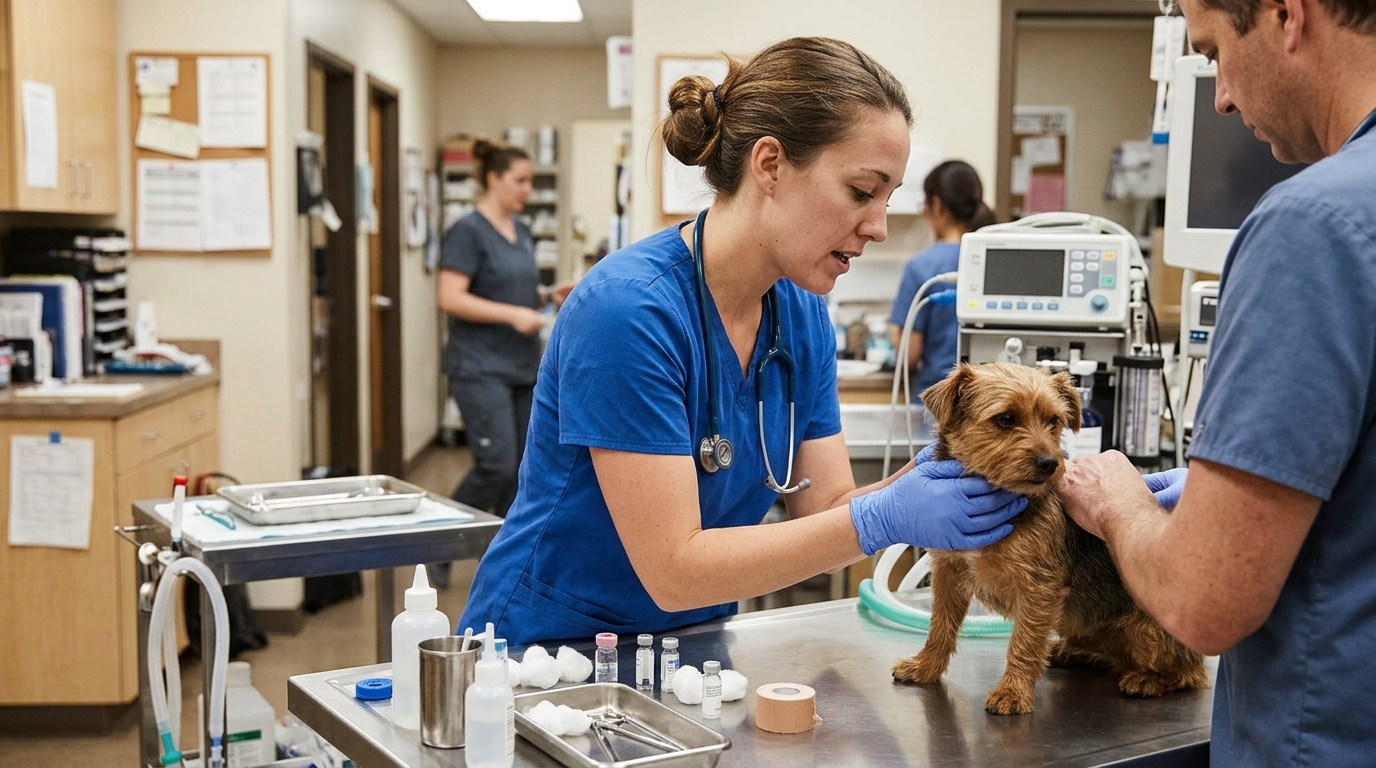
Most veterinary technicians enter the field through a two-year associate degree from a program accredited by the AVMA's Committee on Veterinary Technician Education and Activities (CVTEA), then pass the Veterinary Technician National Examination (VTNE) and apply to a state board for a license, registration, or certificate (U.S. Bureau of Labor Statistics, 2025; AVMA, undated).
Technologists complete a four-year bachelor's degree instead — two years longer than the technician route — and both groups typically sit the same credentialing exam (U.S. Bureau of Labor Statistics, 2025). Rules vary sharply by state, so check your state veterinary board before you enroll anywhere.
What the Job Involves Day to Day
You work under the supervision of a licensed veterinarian, running the medical tasks that support diagnosis and treatment (U.S. Bureau of Labor Statistics, 2025-08-28). A typical shift means you restrain and position animals for examination, draw blood and run in-house lab tests, take and process radiographs, induce and monitor anesthesia during surgery, administer medications and vaccines, place IV catheters, clean teeth with an ultrasonic scaler, and record observations of animal behavior in the practice management software.
You also prep surgical packs, sterilize instruments in an autoclave, give emergency first aid, and explain discharge instructions to owners.
Most of this happens indoors in private clinics and animal hospitals, though laboratories, colleges and universities, and humane societies also hire technicians (U.S. Bureau of Labor Statistics, undated). Expect to stand for most of the shift, lift and carry animals onto tables and into kennels, wear lead gowns and thyroid shields during x-rays, and work through kennel noise. The Bureau of Labor Statistics notes the work can be physically and emotionally demanding, including euthanasia appointments.
Path to Becoming a Veterinary Technician
- Finish high school or an equivalent and take biology, chemistry and math. Many programs also ask for documented hours shadowing or volunteering in a veterinary clinic, shelter or stable before you apply — plan a few months to accumulate them.
- Choose a CVTEA-accredited program. Nearly all states require graduation from a program accredited by the AVMA's Committee on Veterinary Technician Education and Activities to be eligible for state credentialing, and there are more than 200 of them (AVMA, undated). Compare on-campus and distance options, and confirm accreditation directly on the AVMA list.
- Complete the degree. Technicians typically earn a 2-year associate degree; technologists earn a 4-year bachelor's degree (U.S. Bureau of Labor Statistics, 2025). Accredited programs must ensure graduates are competent in over 300 essential skills, so expect a signed skills log alongside your transcript (AVMA, undated).
- Log clinical and preceptorship hours. Your program will place you in a clinic, teaching hospital or shelter to practice anesthesia monitoring, radiography, dentistry and surgical assisting under supervision, usually in the final term.
- Apply to the AAVSB for the VTNE. Eligibility generally requires graduation from an AVMA- or CVMA-accredited program, or a program approved by your jurisdiction (vettechprep, undated). The exam fee is cited at $365, submitted with the application (Mometrix, undated).
- Sit and pass the VTNE. It is computer-based and multiple-choice: 150 scored questions plus 20 unscored pilot questions in a three-hour limit, offered in three windows a year — spring, summer and winter (vettechprep, undated). Scores are scaled from 200 to 800 with 425 to pass (Mometrix, undated). Allow 8–12 weeks of study.
- Apply to your state board. Most states require you to pass an exam before being registered, licensed, or certified, and each regulates the occupation differently (U.S. Bureau of Labor Statistics, 2025). Some states offer alternate routes to credentialing (NAVTA, undated).
- Apply for clinic jobs and keep your credential current. NAVTA recommends renewal every two years with 24 continuing education units per cycle, no more than 6 of them non-medical (NAVTA, undated).
Timeline at a Glance
- Before enrollment (3–6 months): gather clinic shadowing or volunteer hours, request transcripts, and submit program applications.
- Year 1: anatomy and physiology, pharmacology, animal nursing, lab animal medicine, and hands-on labs in restraint, venipuncture and radiographic positioning.
- Year 2: anesthesia, surgical nursing, dentistry, clinical pathology, plus a supervised preceptorship or externship in a practice. You sign off the program's essential skills list in this period (AVMA, undated).
- Year 2, final term: submit the VTNE application to the AAVSB and pick a testing window — spring, summer or winter (vettechprep, undated).
- Month 1–3 after graduation: sit the three-hour VTNE and wait for your scaled score of 200–800; 425 passes (Mometrix, undated).
- Month 3–6 after graduation: file your state board application with transcript, exam result and background documentation, then start applying for clinic roles.
- Every 2 years thereafter: renew the credential and complete continuing education. Requirements range from 8 CEUs every 2 years in North Dakota to 45 CEUs every 3 years in New York (NAVTA, undated).
Technologists add roughly two more years of coursework before the same exam step (U.S. Bureau of Labor Statistics, 2025).
Requirements Checklist
- High school diploma or equivalent, with the science prerequisites your chosen program lists.
- Graduation certificate and official transcript from a CVTEA-accredited associate or bachelor's veterinary technology program (AVMA, undated).
- A completed essential-skills checklist signed by program faculty, covering the 300-plus competencies accredited programs must verify (AVMA, undated).
- Documented preceptorship or externship hours in a veterinary practice, teaching hospital or shelter, as specified by your program.
- An approved VTNE application submitted to the AAVSB with the $365 fee (vettechprep, undated; Mometrix, undated).
- A passing VTNE score of 425 or higher on the 200–800 scale (Mometrix, undated).
- State board application for licensure, registration or certification, including any jurisprudence exam or background check your state requires (U.S. Bureau of Labor Statistics, 2025).
- Current rabies pre-exposure vaccination status and radiation safety training where your employer or state requires it.
Education and Cost Comparison
| Route | Duration | Cost | Credentialing and pay |
|---|---|---|---|
| CVTEA-accredited associate degree (veterinary technician) | 2 years (U.S. Bureau of Labor Statistics, 2025) | Tuition varies by school, state and residency status — check each program's published cost sheet; add the $365 VTNE fee (Mometrix, undated) | Eligible for the VTNE and state credentialing in nearly all states (AVMA, undated). For current median pay, see the Occupational Outlook Handbook (U.S. Bureau of Labor Statistics, 2025) |
| AVMA-accredited bachelor's degree (veterinary technologist) | 4 years — two years longer than the associate route (U.S. Bureau of Labor Statistics, 2025) | Higher total tuition than a two-year program; four years of fees rather than two, plus the same $365 exam fee (Mometrix, undated) | Same VTNE and state credentialing step; the title 'Veterinary Technologist' is designated for bachelor's graduates (NAVTA, undated). Wage percentiles are published on O*NET OnLine using BLS wage data (2024) |
| State alternate route (on-the-job experience), where offered | Varies by state; not available in most | Lower tuition cost, but limits where you can transfer | Some states provide alternate routes to credentialing (NAVTA, undated); confirm with your state board before relying on it |
Pay is usually hourly in private practice, with shift differentials for overnight emergency work and sometimes bonuses for specialty certification. Check current national and percentile figures on the Bureau of Labor Statistics Occupational Outlook Handbook (2025) and O*NET OnLine (2024) rather than recruiter estimates, and compare them against your state's cost of living.
Frequently asked questions
Do I have to be licensed to work as a veterinary technician?
Most states require you to pass an exam before being registered, licensed, or certified, but each state regulates the occupation differently (U.S. Bureau of Labor Statistics, 2025). A NAVTA review found that the veterinary practice acts of 29 states, DC and Puerto Rico lack restrictions on who may use the title 'veterinary technician,' while only 11 states both define and restrict it, and 5 states attach criminal penalties to misrepresentation (AVMA, undated). Check your own state board before assuming the credential is optional, because employers and insurers often require it regardless.
How hard is the VTNE and what happens if I fail?
The exam runs three hours and contains 150 scored multiple-choice questions plus 20 unscored pilot items, delivered by computer (vettechprep, undated). Scores are scaled from 200 to 800 and you need 425 to pass (Mometrix, undated). It is offered in three windows a year — spring, summer and winter — so a retake generally means waiting for the next window and reapplying through the AAVSB.
Can I train online instead of on campus?
Some CVTEA-accredited programs are offered at a distance, but every accredited program must still verify graduates are competent in over 300 essential skills, so you will complete supervised hands-on hours at an approved clinical site near you (AVMA, undated). Confirm the program appears on the AVMA's accredited list before you pay anything, since nearly all states require that accreditation for credentialing. Accreditation is reviewed on five-year cycles through an application, self-study report and site visit.
What does it cost to keep the credential once I have it?
Expect a renewal fee set by your state board plus continuing education. NAVTA recommends renewal every two years with 24 CE units per cycle and no more than 6 non-medical credits, though actual requirements range from 8 CEUs every two years in North Dakota to 45 CEUs every three years in New York (NAVTA, undated). Many employers cover conference registration or online CE subscriptions, so ask during interviews.
Is it hard to find a first job after graduating?
Roughly 5,000 students graduate each year from the more than 200 CVTEA-accredited programs (AVMA, undated), and the Bureau of Labor Statistics publishes projected employment growth and average annual openings for the occupation through 2035 — check those figures directly before you commit. Preceptorship sites frequently hire their own students, so treat the clinical placement in your final term as an extended interview. Emergency and overnight shifts are usually the easiest entry points.
Sources
- U.S. Bureau of Labor Statistics — Veterinary Technologists and Technicians : Occupational Outlook Handbook (2025-08-28)
- U.S. Bureau of Labor Statistics — Veterinary Technologists and Technicians : Occupational Outlook Handbook