How to Get a Job as a Truck Driver: Step-by-Step Guide
What carriers check before they call you back, how CDL training and ELDT rules fit into your timeline, and how to put driving experience on paper.
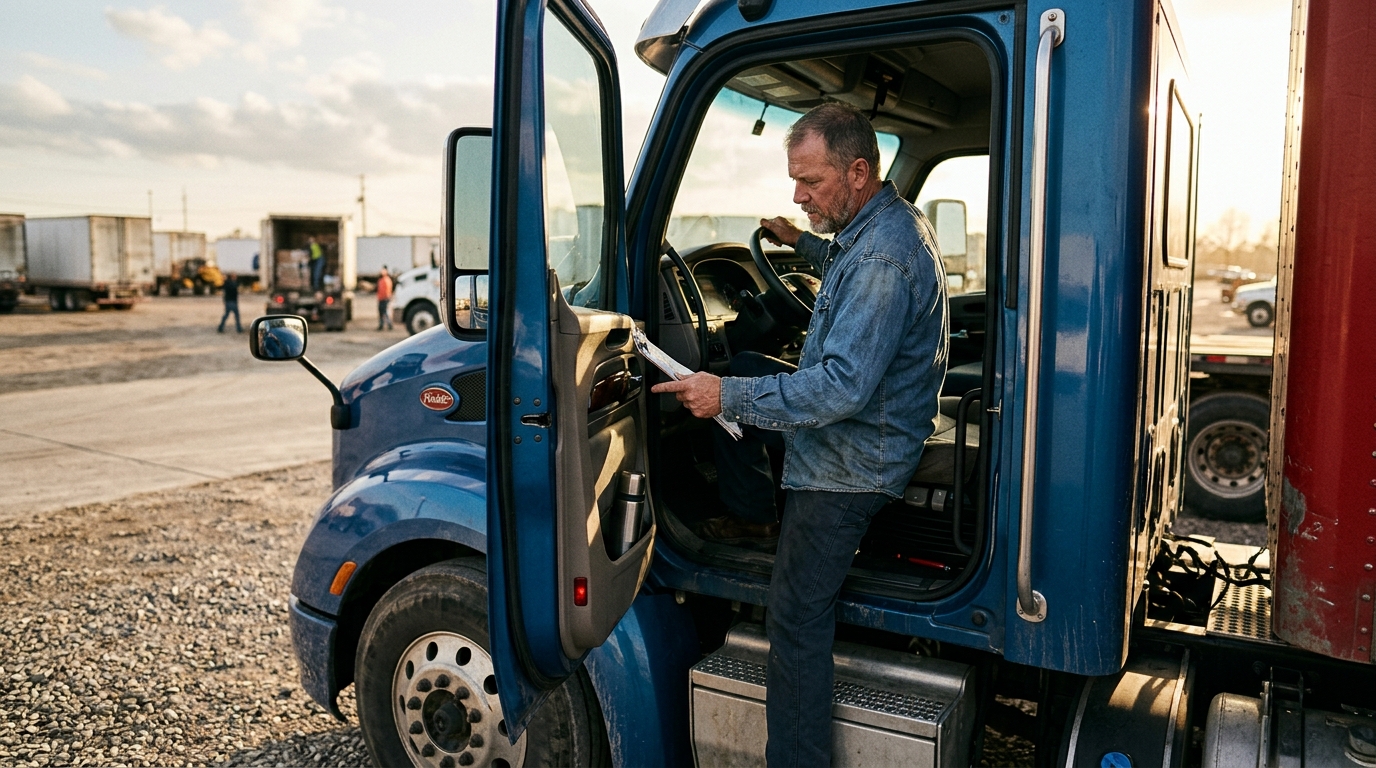
Getting hired as a truck driver runs on two tracks at once: the licensing track (a commercial driver's license, the right endorsements, a clean record and a current medical card) and the application track (a one-page resume, a carrier-specific application, a phone screen and orientation). Most new drivers go through a private truck-driving school or community college program lasting between 3 and 6 months and finish with a certificate (U.S. Bureau of Labor Statistics, 2025), then apply while finishing school rather than after.
This guide walks the sequence in order — timeline, steps, what belongs on which document, and what to do in the days after the interview.
Typical Timeline to Land the Job
Timelines vary by state, by school availability and by whether you already hold a CDL. Treat these as planning ranges, not guarantees.
Weeks 0–2: eligibility and paperwork. Confirm you meet the basics before spending money. Most companies require a high school diploma or equivalent (U.S. Bureau of Labor Statistics, 2025). Federal rules require CDL drivers to keep a clean driving record and pass a physical exam every two years, with random drug and alcohol testing (U.S. Bureau of Labor Statistics, 2025), and a driver must be able to hear a forced whisper in one ear at 5 feet, with or without a hearing aid (U.S. Bureau of Labor Statistics, 2025).
Weeks 2–6: permit and enrollment. Study for and take the knowledge test for a commercial learner's permit. A state may issue a CLP to a driver who has not yet completed entry-level driver training, but it cannot administer the CDL skills or knowledge test if it cannot electronically verify ELDT requirements are met (FMCSA).
Months 1–6: training. Private truck-driving schools and community college programs run between 3 and 6 months and end in a certificate of completion (U.S. Bureau of Labor Statistics, 2025). Start applying in the last 4–6 weeks, not after graduation — many carriers recruit students.
Weeks 1–3 after the skills test: screening and interviews. Qualifications for a CDL vary by state but generally include a knowledge test and a driving test (U.S. Bureau of Labor Statistics, 2025). Once you pass, expect a recruiter phone screen, a long carrier application covering your work history, and a background and record check.
Weeks 2–6: offer and orientation. Offers are usually conditional on the drug screen, physical and record check clearing. After hiring, drivers normally receive several weeks of on-the-job training, driving with an experienced mentor-driver (U.S. Bureau of Labor Statistics, 2025).
If you already hold a CDL with recent verifiable experience, the first three stages drop out and the whole process can run two to four weeks. Hiring demand is steady rather than booming: employment is projected to grow 4 percent from 2025 to 2035, about as fast as average, with about 214,500 openings projected each year on average over the decade (U.S. Bureau of Labor Statistics, 2025).
Step-by-Step Plan
1. Pull your own driving record and medical card status. Order your state MVR and write down every violation and its date. Recruiters will see it; you want to know what's on it before they ask. Confirm your DOT medical certificate has more than 90 days left, or book the exam now. 2. Pick an ELDT-listed training provider. Check the provider appears on FMCSA's Training Provider Registry before enrolling — the regulations require training from a listed provider before the Class A or Class B CDL skills test, the S or P skills test, or the H knowledge test (FMCSA). Note that the ELDT rules do not apply to people who are not required to hold a CDL under 49 CFR part 383, or where the state has waived the skills test (FMCSA). 3. Decide on endorsements before you finish school. Hazmat (H) requires an additional knowledge test and a background check (U.S. Bureau of Labor Statistics, 2025), and adding tanker or doubles widens the freight you can haul. Decide early so the testing fits inside your training window. 4. Build a target list of 15–20 carriers across three categories: local/home-daily, regional, and over-the-road. For each, write down the trailer type, the home-time schedule and whether they hire recent CDL graduates. Apply across all three — the local jobs usually want experience, the OTR jobs usually train. 5. Write a one-page driver resume with measurable bullets. Quantify everything a dispatcher cares about: - "Ran 110,000+ miles per year on 48-state dry van routes with 4 consecutive accident-free years." - "Completed 22–26 delivery stops per shift on a 180-mile regional LTL route, averaging 98% on-time arrivals." - "Logged hours on electronic logging device with zero hours-of-service violations across 36 months." 6. Match the posting's exact wording for applicant tracking systems. Carrier portals and ATS filters search literal strings. Put "Class A CDL," the endorsement letters in parentheses — "Hazmat (H)," "Tanker (N)," "Doubles/Triples (T)" — plus trailer types ("reefer," "flatbed," "end dump") in a plain-text "Licenses & Endorsements" line near the top. Keep one column, no tables, no graphics, no text inside headers or footers, and save as FirstLast_Resume.pdf. 7. Complete the carrier application the same day you apply. The resume gets you read; the application is the record. Have ten years of addresses, employer phone numbers and exact employment dates in one file so you can fill it in without guessing. 8. Prepare three STAR stories — one on a safety decision, one on a customer or shipper problem, one on equipment failure.
Sample answer: "Tell me about a time you had to stop a load."
Situation: I was 40 miles into a 600-mile reefer run when the trailer temperature readout climbed 6 degrees above the setpoint on a produce load. Task: I had to protect roughly $40,000 of temperature-sensitive freight without blowing the delivery appointment. Action: I pulled into the next safe truck stop, photographed the reefer display, called dispatch within 10 minutes, and logged the stop on the ELD as on-duty not driving so my hours-of-service record stayed accurate. Dispatch routed me to a service point 12 miles back for a thermostat sensor replacement. Result: The load delivered 90 minutes late instead of being rejected, the receiver accepted it in full, and the carrier added the sensor check to its pre-trip reminder list.
- Confirm the pay structure in writing before you accept. Driver pay is usually built from a per-mile rate, an hourly rate, per-stop or percentage-of-load pay, plus detention, layover, safety and referral bonuses. Ask which components apply, how miles are calculated, and when the rate increases. Compare against the median annual wage BLS publishes for heavy and tractor-trailer truck drivers (U.S. Bureau of Labor Statistics, 2025) and against current postings for the same lane type in your state.
Resume vs. Cover Letter vs. LinkedIn
| Content item | Where it goes | Why not the others |
|---|---|---|
| CDL class and endorsement letters (A, H, N, T, P, S) | Resume, top line under your name | The cover letter shouldn't spend a sentence on facts a recruiter scans for in two seconds; LinkedIn can list them in the Licenses section instead |
| Summary of experience ("6 years, 650,000 miles, dry van and reefer") | Resume summary, 2 lines maximum | LinkedIn's About section can carry a longer version; the cover letter opens with the specific job instead |
| Headline with lane type and availability ("Class A CDL Driver — Hazmat, Regional Midwest, home weekends") | LinkedIn headline | A resume has no headline field; a cover letter states availability in the closing paragraph |
| Skills and equipment list (ELD systems, air brakes, chains, pallet jack, flatbed securement, backing in tight docks) | Resume skills section, as plain keywords | Prose in a cover letter hides these from ATS keyword matching |
| Accident-free years and safety awards | Resume bullets, with the number of years attached | LinkedIn can repeat them in Honors; don't make this the whole cover letter |
| Explanation of a gap, a job change pattern, or a violation | Cover letter, one short factual paragraph | A resume should not editorialize; LinkedIn is public and permanent |
| Why this carrier and this lane | Cover letter, first paragraph, naming the route or account from the posting | Generic on a resume, invisible on LinkedIn |
| Work history with employer names, dates, trailer types and average weekly miles | Resume and LinkedIn Experience, identical dates | Mismatched dates between the two are a common screening flag |
| References from dispatchers or safety managers | Supplied on request, named on the carrier application | Takes space on a one-page resume and exposes contacts publicly on LinkedIn |
| Medical card and MVR details | Carrier application only | Not resume content; never post on a public profile |
Follow-Up After the Interview
- Within 24 hours, send a thank-you email that names the specific lane, account or trailer type the recruiter described, and restates your CDL class and endorsements in one line.
- Within 24 hours, email any document the recruiter asked for — DOT medical card, CDL front and back, school certificate of completion — as a single PDF named FirstLast_DriverDocs.pdf.
- Within 48 hours, call each former employer on your application and confirm the phone number, contact name and employment dates you listed are still correct.
- Within 48 hours, complete and return the background-check and drug-screen consent forms on the day they arrive, not the day they're due.
- Within 3 business days, schedule the road test or orientation date the recruiter offered, and put the travel details in writing by email.
- At 7 days with no reply, send one follow-up email asking for a status update and your application number.
- Every week until you sign, submit three new applications to carriers on your target list.
- Before accepting, request the offer in writing showing pay structure, home-time schedule, equipment assignment, orientation length and start date, and read it before you give notice.
Frequently asked questions
Can I apply to carriers before I have my CDL in hand?
Yes, and most students should. Many carriers recruit from training programs and will issue a conditional pre-hire letter while you finish, subject to you passing the skills test and the background screening. Say clearly in your first line which test date you are booked for and which state will issue the license.
I have no truck experience at all. What goes on the resume?
Lead with the training program, the certificate of completion and the endorsement letters, then quantify transferable work: "Operated a 26-foot box truck on a 14-stop daily route for 18 months, zero chargeable incidents," or "Loaded and secured 30+ pallets per shift using forklift and load bars." Volume, weight, stops and incident-free time are the numbers that read as relevant.
How should I handle a violation or an accident when the recruiter brings it up?
State the date, what happened and what changed afterward, in three sentences, without blaming the other driver or the weather. Recruiters have already seen the record, so the answer they are grading is whether your account matches it. Follow with the concrete habit you adopted — a longer following distance, a written pre-trip checklist — and stop talking.
Is a company-sponsored CDL school better than paying for training myself?
Sponsored training removes the upfront cost but usually comes with a contract committing you to the carrier for a set period, with repayment owed if you leave early. Paying yourself keeps you free to choose the lane, trailer type and home-time schedule you actually want. Either way, confirm the provider appears on FMCSA's Training Provider Registry and get the contract terms in writing before you sign.
How long after orientation will I be driving alone?
Expect several weeks of on-the-job training with an experienced mentor-driver after you are hired (U.S. Bureau of Labor Statistics, 2025). The exact length depends on the carrier, the freight type and how quickly you clear their skills checkpoints. Ask during the interview how many weeks the mentor phase runs and how the pay works during it.
Sources
- U.S. Bureau of Labor Statistics — Heavy and Tractor-Trailer Truck Drivers : Occupational Outlook Handbook (2025)
- Federal Motor Carrier Safety Administration (FMCSA) — Entry-Level Driver Training Requirements for CDL Applicants