How to Write a Resume for a Truck Driver
Put your CDL class, endorsements, and clean driving record at the top of page one, then back up your experience with miles, loads, and inspection results.
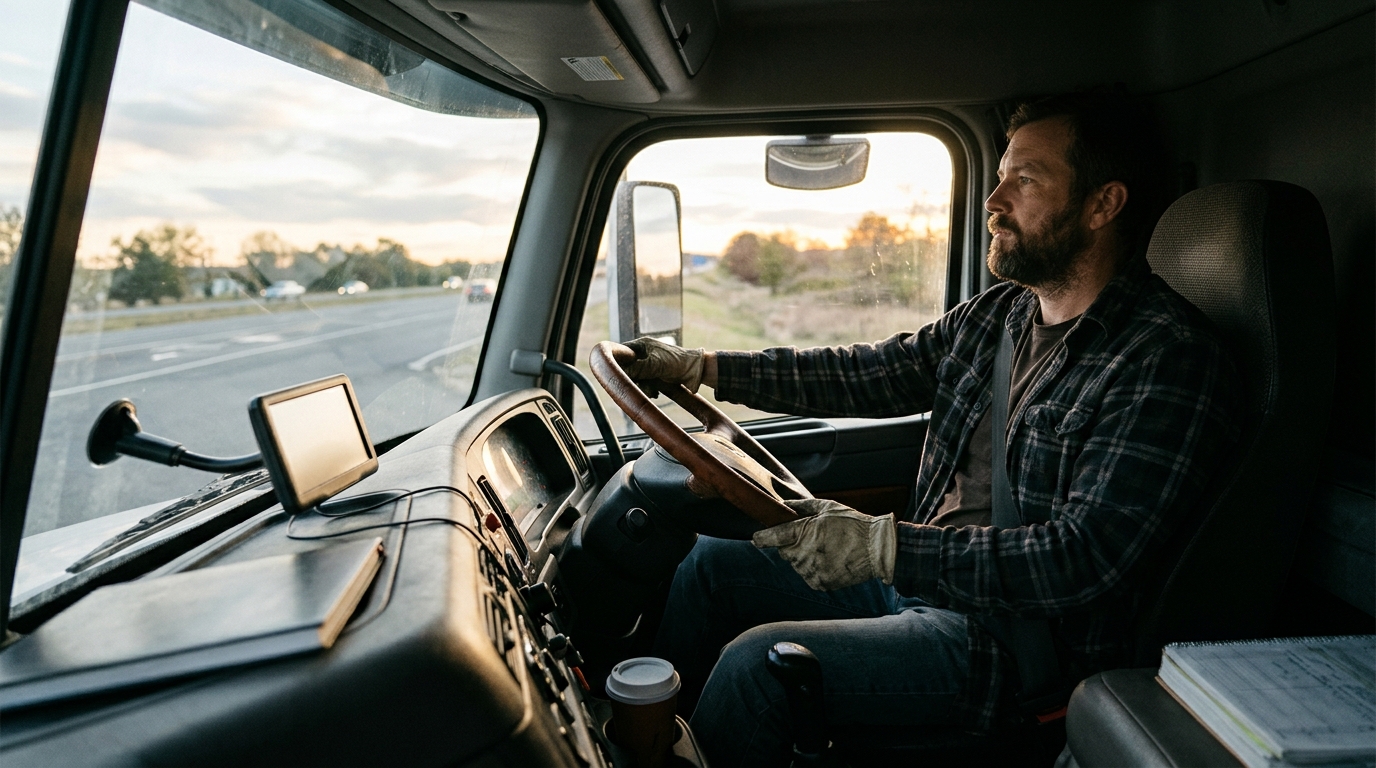
A truck driver resume is read fast, usually by a recruiter checking three things: what class of CDL you hold, what endorsements come with it, and whether your driving and inspection record is clean. Put those facts in the top third of page one, then use your experience section to show miles run, loads secured, and logs kept to federal rules.
Most of what follows applies whether you are applying for over-the-road, regional, or local work. Requirements for licensing and medical certification are set federally and by your state, so check the current rules with the Federal Motor Carrier Safety Administration and your state licensing agency before you write.
What Hiring Managers Look For
Start with the license. The Federal Motor Carrier Safety Administration defines a Class A CDL as covering any combination of vehicles with a gross combination weight rating of 26,001 pounds or more, including a towed unit rated over 10,000 pounds, while a Class B covers a single vehicle rated 26,001 pounds or more (Federal Motor Carrier Safety Administration, undated). Those are different jobs, so write the class out rather than just "CDL." One truck driver resume guide advises featuring your CDL classification, safety record, and route experience prominently (Monster, undated), and that is still the clearest way to open the page.
Endorsements are the second filter. The FMCSA lists codes including T for double and triple trailers, N for tank vehicle, H for hazardous materials, X for the combined tank and hazmat endorsement, P for passenger, and S for school bus (Federal Motor Carrier Safety Administration, undated). A recruiter hiring for fuel or chemical hauling may search a resume database for "tanker," "N endorsement," and "hazmat" separately, so include both the code and the plain-English word.
Training matters where it is required by rule. Under the FMCSA's Entry-Level Driver Training regulations, first-time Class A or Class B applicants, drivers upgrading a Class B to a Class A, and those seeking a first-time S, P, or H endorsement must train with a provider listed on the FMCSA Training Provider Registry before taking the skills test — or, for the hazmat endorsement, the knowledge test (Federal Motor Carrier Safety Administration, undated). If you completed that training, say so in your education section with the completion date.
After licensing, hiring managers look for evidence you can do the recorded parts of the job: checking load documentation for completeness and accuracy, inspecting loads to confirm cargo is secure, checking vehicles for mechanical, safety, and emergency equipment condition, maintaining logs of working hours under state and federal regulations, reading bills of lading, and coupling and uncoupling trailers (O*NET OnLine, 2026). Name the tools you use for each — the electronic logging device brand, the fleet maintenance app you file defects in, the strap and chain configurations you use for flatbed loads. A driver who writes "filed pre- and post-trip inspection reports daily, including defects" is easier to trust than one who writes "safe driver."
Finally, list equipment. Trailer types (dry van, reefer, flatbed, tanker, doubles), transmission type, and route territory tell a recruiter whether you can start without retraining. ONET records sample titles for this occupation including CDL Driver, Line Haul Driver, Log Truck Driver, Over the Road Driver (OTR Driver), Road Driver, Semi Truck Driver, and Tractor Trailer Driver (ONET OnLine, 2026) — mirror whichever one appears in the posting in your own headline so the wording matches.
How to Write the Resume
- Headline and summary. Put your target title, license class, and years driving in two or three lines at the top. Adapt: "Class A CDL tractor-trailer driver, 6 years OTR and regional, hazmat (H) and tanker (N) endorsements, 480,000 accident-free miles across 38 states." If you are new, say what you are licensed for and what you trained on instead of inflating experience.
- Licenses and certifications. Give this its own block near the top, formatted one item per line with issuing body and year. One published truck driver resume example lists entries in the form "Commercial Driver's License (Class A), State of Utah, 2009" and "First Aid/CPR/AED certification, American Red Cross, 2010" (Zety, undated). Follow that pattern with your own state and dates, and add endorsement codes, your medical examiner's certificate status, and any TWIC or forklift certification you hold.
- Skills. Use a short list of concrete nouns pulled from the posting, not adjectives. Adapt: "Dry van, reefer, flatbed; doubles; electronic logging device hours-of-service entry; pre- and post-trip DVIR; load securement with chains, straps, blocks, and tarps; bill of lading and BOL discrepancy checks; trailer coupling and uncoupling." These duties — securing cargo with ropes, blocks, chains, and covers, inspecting trailers before and after trips and recording defects, and maintaining an hours log under federal and state regulations — are listed among the occupation's typical tasks (U.S. Bureau of Labor Statistics, 2025).
- Experience. One entry per carrier, with dates, route type, and equipment on the line under the employer name, then three to five quantified bullets. Adapt the equipment line: "Regional dry van and reefer, 10-speed manual, Midwest lanes, average 2,400 miles per week."
- Education and training. List your high school diploma or equivalent, then your truck driving school with the completion date and a note that the provider was listed on the FMCSA Training Provider Registry if that applies to your license. Typical entry-level education for this occupation is a postsecondary nondegree award, and drivers usually hold a high school diploma and attend a professional truck driving school (U.S. Bureau of Labor Statistics, 2025).
- Record and extras. Close with a short block for your driving record summary, clean-inspection history, and any safe-driving awards. Adapt: "Zero preventable accidents and no moving violations in 5 years; 11 consecutive clean DOT roadside inspections."
Example Resume Bullets
Long-haul mileage
Over-the-road miles
Drove 125,000 miles per year across 38 states in a Class A tractor-trailer with zero preventable accidents over 4 years.
Load securement
Flatbed securement
Secured an average of 9 flatbed loads per week with chains, straps, edge protectors, and tarps, passing 14 consecutive DOT roadside inspections with no securement violations.
Heavy combination equipment
Weight and accounts
Operated tractor-trailers grossing over 25,000 pounds and built working relationships with 20-plus accounts on a fixed regional lane, modeled on a published truck driver resume sample (Resume Companion, undated).
Inspections and defect reporting
Pre- and post-trip DVIR
Completed 2 documented inspections per shift across 240 shifts a year, reporting 31 mechanical defects that were repaired before dispatch and taking 2 units out of service for brake faults.
Hours-of-service compliance
Electronic logs
Maintained hours-of-service logs on an electronic logging device for 3 years with zero form-and-manner or HOS violations across 9 audited log reviews.
On-time delivery and dispatch contact
Schedule performance
Delivered 1,100-plus loads at 98 percent on-time, reporting delays, weather closures, and 3 roadside incidents to dispatch within 15 minutes of occurrence.
Local and multi-stop work
Route density
Ran 14 to 18 stops per day on a metro route, verifying bills of lading against 400-plus pallets a week and resolving 23 shortage claims with the warehouse team.
Before You Submit
- Save the file as FirstLast_Resume.pdf and send PDF unless the posting asks for .doc.
- Write your CDL class and every endorsement code in the top third of page one, using both the letter and the word (for example, "H — hazardous materials").
- Copy three to five exact phrases from the job posting — such as "Class A CDL," "doubles," "hours of service," or "OTR" — into your skills or experience lines so an applicant tracking system matches the wording it was given.
- Replace any text sitting in a header, footer, text box, or two-column layout with plain single-column body text, since those elements are frequently dropped when an ATS parses the file.
- Check that every experience bullet contains a number: miles, loads, stops, inspections, accounts, or years accident-free.
- Confirm your phone number and email appear as plain text on line two and that your voicemail greeting states your name.
- List the states or regions you have driven, and whether you are available for OTR, regional, or local, on one line near the top.
- Verify dates on your license, medical examiner's certificate, and school completion against the actual documents before sending.
Frequently asked questions
I just finished CDL school and have never driven commercially. What goes in my experience section?
Use the training itself: list your school, the completion date, hours behind the wheel, backing maneuvers practiced, and the trailer types you trained on, each with a number. No work experience in a related occupation is typically required to enter this occupation, and typical on-the-job training is short-term (U.S. Bureau of Labor Statistics, 2025), so carriers hiring new drivers expect a training-heavy page and read your record and attitude instead.
Should I put my MVR or accident history on the resume?
Put a one-line summary of your record — years accident-free, preventable accidents, moving violations, clean inspections — rather than attaching the report itself. Carriers will pull your motor vehicle record and employment history during screening anyway, so the number you write must match what they find.
How do I write a cover letter for an over-the-road job when home time is the real issue?
Address availability directly in the second paragraph: say how many days out you can run and how often you need home time. Long-haul driving is described as a lifestyle choice because drivers can be away from home for days or weeks at a time (U.S. Bureau of Labor Statistics, 2025), and saying plainly what you can do saves you both a wasted interview.
Is it worth applying widely if I only hold a Class B?
Yes, but target postings that match the vehicle. A Class B covers a single vehicle rated 26,001 pounds or more, or such a vehicle towing a unit not exceeding 10,000 pounds (Federal Motor Carrier Safety Administration, undated), which fits dump, box, and refuse work rather than tractor-trailer lanes. If you plan to upgrade, note on the resume that you are enrolled with a provider on the FMCSA Training Provider Registry, since that training is required for a Class B to Class A upgrade.
How should I describe my availability for the hiring market right now?
Keep it factual: start date, license class, endorsements, and route preference. Employment of heavy and tractor-trailer truck drivers is projected to grow 4 percent from 2025 to 2035, with about 214,500 openings projected each year on average over the decade, largely from workers transferring occupations or leaving the labor force (U.S. Bureau of Labor Statistics, 2025), so postings turn over often and a resume you can update in ten minutes is worth more than a polished one you rewrite twice a year.
Sources
- U.S. Bureau of Labor Statistics — Heavy and Tractor-Trailer Truck Drivers : Occupational Outlook Handbook (2025)
- O*NET OnLine (U.S. Department of Labor, Employment and Training Administration) — 53-3032.00 - Heavy and Tractor-Trailer Truck Drivers (2026)