Pharmacy Technician vs Pharmacist: Comparing Duties, Training, and Day-to-Day Work
One role counts, labels and stocks under supervision; the other verifies the order, counsels the patient and holds the license the pharmacy operates on.
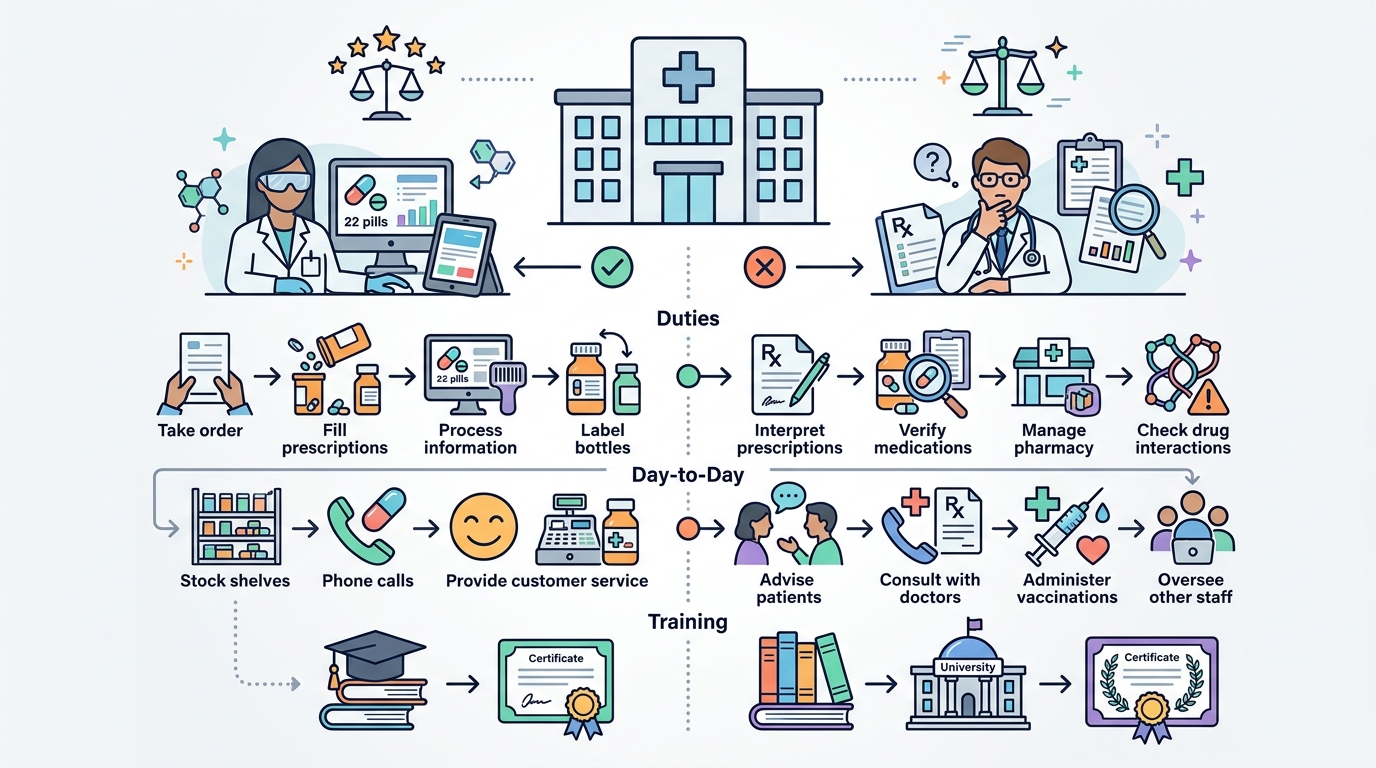
A pharmacy technician prepares and dispenses what a prescription calls for: entering the order, counting tablets, labeling vials, billing insurance and restocking shelves. A pharmacist checks that work, approves the final product, counsels patients, screens for drug interactions and makes clinical calls that legally cannot be delegated.
The gap between them is mostly training length and legal authority. Technician training is usually measured in months; a Doctor of Pharmacy degree takes four academic years on top of undergraduate prerequisites, followed by two licensing exams.
Side-by-Side Comparison
| Factor | Pharmacy Technician | Pharmacist |
|---|---|---|
| Median pay | Paid hourly in nearly all settings, with shift differentials for evenings, weekends and overnight hospital coverage; look up the current median in the BLS Occupational Outlook Handbook entry for pharmacy technicians and the OEWS state tables. | Paid an annual salary in most retail and hospital jobs, hourly for per-diem and floater work; look up the current median in the BLS Occupational Outlook Handbook entry for pharmacists and your state's OEWS table. |
| Typical hours | 8- to 12-hour shifts covering store or hospital hours, including weekends and holidays; 24-hour hospital pharmacies staff overnight technician shifts. | 8- to 12-hour shifts, often 12-hour blocks in hospitals and retail; one pharmacist must be on duty whenever the pharmacy is open, so meal breaks are scheduled around that rule. |
| Education required | High school diploma plus employer or program training; most states require registration with the state board of pharmacy, and many employers require the PTCB Certified Pharmacy Technician (CPhT) credential earned by passing the PTCE, with prep programs running roughly 4 weeks to 12 months. | Doctor of Pharmacy (PharmD) from an ACPE-accredited program: four academic years after at least two years of prerequisite college science, then the NAPLEX and the MPJE or state law exam for licensure. |
| Physical demands | Stand and walk for most of the shift indoors; lift and shelve stock cases, cartons of IV fluid and bulk bottles; push delivery carts to nursing units in hospitals. | Stand at the verification counter or walk patient-care units on rounds for most of the shift; minimal lifting, but long periods on your feet and at a screen reviewing profiles. |
| Primary duties | Enter prescriptions, count and pour medication, label vials, bill insurance claims and resolve rejections, restock automated dispensing cabinets, compound non-sterile preparations and prepare sterile IVs in a laminar airflow hood under USP 797 and 800 rules. | Verify each filled prescription, screen profiles for interactions, allergies and dosing errors, counsel patients, call prescribers to clarify or change orders, administer immunizations, sign for controlled-substance receipts and supervise technicians. |
Day-to-Day Differences
A technician's hour looks like a queue. You pull up the next order in the pharmacy system, type the sig, select the NDC, count tablets on a tray with a spatula, label the vial and set it in the bin for check. Between fills you work the insurance rejections — prior authorization codes, refill-too-soon messages, wrong bin numbers — and answer the phone. In a hospital you refill Pyxis cabinets on the floors, pull controlled substances against a log and gown up to compound IVs in the cleanroom.
A pharmacist's hour is interruption-driven verification. You check the technician's work against the original order, catch a dose that is wrong for the patient's kidney function, call the prescriber, then step out to counsel someone starting warfarin or an inhaler. You also administer vaccines, sign DEA 222 forms or their electronic equivalent, and make the judgment call when two drugs on a profile should not be taken together.
The practical contrast: technicians are measured on throughput and accuracy of what they prepare; pharmacists are measured on what they approve and what they catch before it leaves the counter.
Who Each Job Fits Best
Pharmacy technician suits you if:
- You want to be working in a pharmacy within months rather than years — certificate programs and PTCE prep typically run a few weeks to a year, versus six or more years of college for a PharmD.
- You are willing to stand, walk and lift stock cases and IV fluid cartons for most of an 8- to 12-hour shift.
- You like solving billing puzzles — chasing a rejected claim through prior authorization and plan codes is a daily task, not an occasional one.
- You would enjoy sterile compounding: gowning, working in a laminar airflow hood and following USP 797 documentation step by step.
Pharmacist suits you if:
- You want the authority to make the final call on a prescription, change a dose with a prescriber and refuse to dispense when something is wrong.
- You can commit to four academic years of PharmD coursework plus the NAPLEX and your state's law exam before you work independently.
- You are comfortable being interrupted mid-verification to counsel a patient or administer an immunization, then returning to the queue without losing your place.
- You want to supervise — technician oversight, intern sign-offs and staffing coverage are part of the license, not an optional extra.
Pay and Advancement
| Item | Pharmacy Technician | Pharmacist |
|---|---|---|
| Entry pay | Hourly, typically at the low end of the range for the first year and before certification; check the 10th-percentile figure for pharmacy technicians in the BLS Occupational Employment and Wage Statistics release (OEWS, May 2024 data) for your state and metro area. | Annual salary from the first licensed day, with little junior tier because licensure is the floor; check the 10th-percentile figure for pharmacists in the BLS OEWS release (May 2024 data) for your state. |
| Median pay | Hourly, with pay gaps between retail, hospital and mail-order settings; see the pharmacy technicians page in the BLS Occupational Outlook Handbook (2024 edition) and the OEWS state tables for the current median. | Annual, with hospital, retail chain and industry roles paying differently; see the pharmacists page in the BLS Occupational Outlook Handbook (2024 edition) and the OEWS state tables for the current median. |
| Typical path to next role | Earn the PTCB CPhT, then add advanced credentials such as the PTCB Sterile Compounding (CSPT) certificate, move to lead or inventory technician, then buyer, 340B technician or technician supervisor; some use tuition support to enter a PharmD program. | Move from staff pharmacist to pharmacy manager or clinical specialist; specialists usually complete a PGY1 residency, sometimes a PGY2, and sit for Board of Pharmacy Specialties certification such as BCPS. Requirements and residency availability differ by employer and state. |
Pay for both roles shifts with state, metro area, shift differential and setting. Compare the BLS figures against current local job postings before you decide.
Frequently asked questions
Can a pharmacy technician become a pharmacist without starting over?
Technician experience counts for a lot in admissions and in your first clinical rotations, but it does not shorten the degree. You still complete the prerequisite college science courses and the full four-year ACPE-accredited PharmD, then pass the NAPLEX and your state law exam. Many technicians keep working part-time while enrolled, since the pharmacy workflow is already familiar.
Do technicians and pharmacists do the same tasks on a slow shift?
The overlap is real but legally bounded. A pharmacist can count tablets and label vials when the queue backs up, but a technician cannot perform the final verification, counsel a patient on a new therapy or accept a new verbal prescription from a prescriber in most states. Check your own state board of pharmacy rules, because the list of permitted technician tasks — including tech-check-tech programs — differs state to state.
Which job has better hours?
Neither is a standard weekday schedule. Both cover weekends, holidays and evening hours, and hospital pharmacies staff both roles overnight. Pharmacists often work 12-hour blocks with fewer days per week, while technicians more commonly get 8-hour shifts and split coverage; the pharmacist is also the one who cannot leave the building while the pharmacy is open.
Is certification required to work as a technician?
It depends on where you work. Most states require registration with the state board of pharmacy, and many employers and hospitals require the PTCB Certified Pharmacy Technician (CPhT) credential or the NHA ExCPT, earned by passing an exam after a training program of roughly a few weeks to a year. Confirm the current rule with your state board before enrolling in anything.