So You Want to Be a Firefighter: Is It a Good Fit?
A look at the 24-hour shift, the CPAT weighted vest, the academy hours, and the kind of person who holds up in all three.
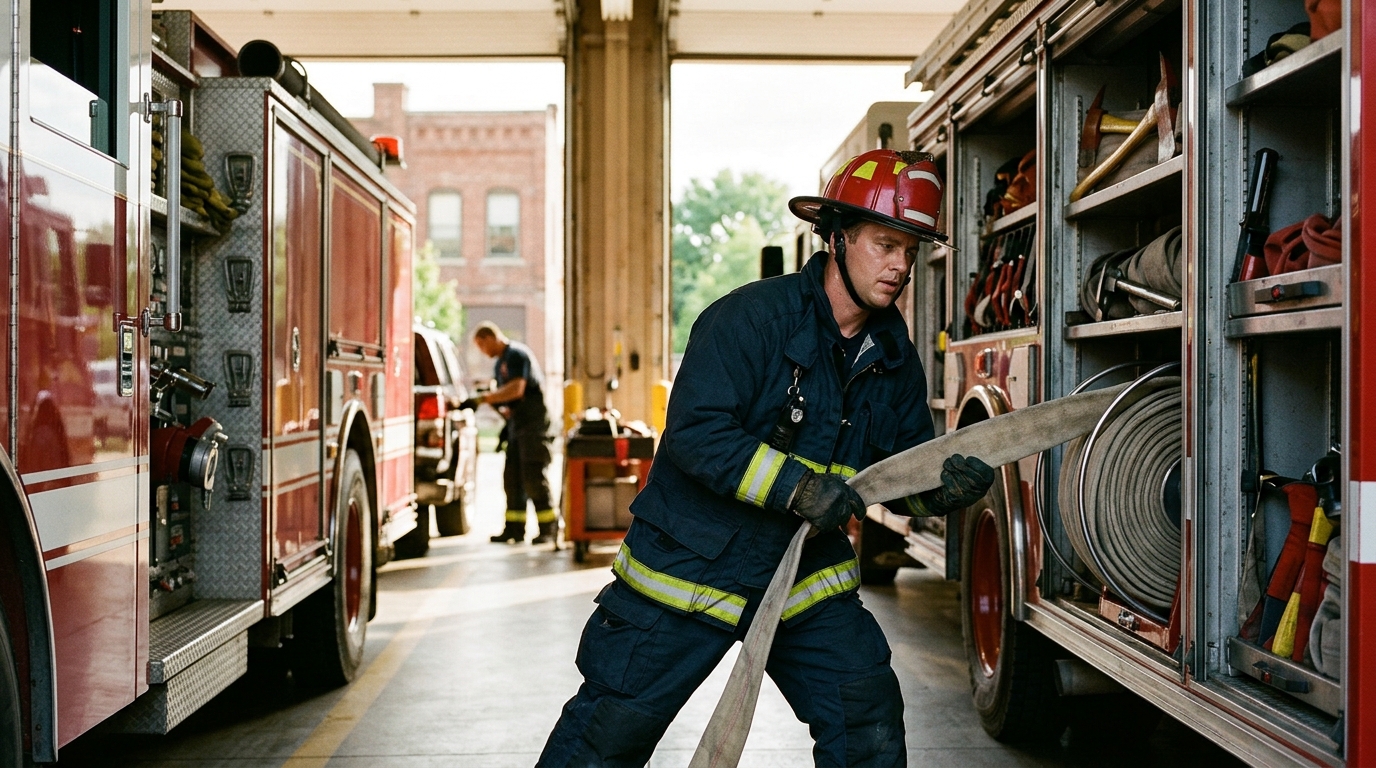
Firefighting suits people who can make a quick decision in smoke, lift and drag heavy things for hours, and then sleep at work. The U.S. Bureau of Labor Statistics (2026-08) describes the job as responding to emergencies, driving firetrucks, putting out fires with hoses and pumps, rescuing occupants, treating the sick and injured, writing incident reports, cleaning equipment and running drills — with shifts at the station that often last 24 hours.
If that mix sounds like a fit, the entry path is fairly standardized: a high school diploma, emergency medical training, written and physical tests, interviews, a medical exam and drug screening, then a fire academy (U.S. Bureau of Labor Statistics, 2026-08).
What a Firefighter Actually Does
A shift starts with relief and a rig check. You take over an apparatus from the off-going crew, inventory the hose loads, start the saws, check SCBA bottle pressures and test the thermal imaging camera, then log anything broken. Equipment cleaning and maintenance is a listed part of the job, not an extra (U.S. Bureau of Labor Statistics, 2026-08).
Mid-morning is usually drills — rescue tactics and equipment use — followed by hydrant checks, building walk-throughs or pre-incident surveys in your first-due area (U.S. Bureau of Labor Statistics, 2026-08).
Then the tones drop. Most of what you run is medical: you treat sick or injured people, often as the first unit on scene (U.S. Bureau of Labor Statistics, 2026-08). On a structure fire you may be pulling a hoseline and operating a pump, or searching and rescuing survivors from a burning building, an accident site or a water hazard (O*NET OnLine, U.S. Department of Labor, 2026).
Back at quarters you write the incident report, repack hose, refill air bottles and shower. You eat and sleep at the station, on call, because shifts often last 24 hours (U.S. Bureau of Labor Statistics, 2026-08).
Wildland work looks different again: one BLS profile of a hotshot crew member describes hiking for miles or taking a helicopter to reach a fire, then cutting brush and trees and scraping vegetation and debris (U.S. Bureau of Labor Statistics, 2015).
Signs This Career Might Fit You
- You decide fast with incomplete information: BLS lists decision-making skills as important because firefighters must make difficult choices quickly — such as whether to enter a structure or fight it from outside (U.S. Bureau of Labor Statistics, 2026-08).
- You hold steady when the situation is ugly: BLS describes mental preparedness as handling the stress of entering burning buildings or treating people in medical emergencies (U.S. Bureau of Labor Statistics, 2026-08).
- Your body recovers well from heavy, repetitive work: the CPAT runs eight events continuously inside 20 minutes in a 50-pound weighted vest, pass/fail, with no credit for finishing faster (allfirefighter.com).
- You can stay on a scene long after the excitement ends: physical stamina matters partly because firefighters remain at disaster scenes for long periods (U.S. Bureau of Labor Statistics, 2026-08).
- You explain conditions clearly over a radio: communication skills are listed because firefighters report conditions at emergency scenes to officers and incoming units (U.S. Bureau of Labor Statistics, 2026-08).
- You can talk to a frightened stranger without rushing them: BLS names compassion, noting firefighters provide emotional support to people in emergencies (U.S. Bureau of Labor Statistics, 2026-08).
- You don't mind living with your coworkers: between calls you sleep, eat and do station duties alongside the same crew for a shift that often lasts 24 hours (U.S. Bureau of Labor Statistics, 2026-08).
Signs This Career Might Not Fit You
- Broken sleep wrecks you: a 24-hour shift means being woken at 3am for a chest-pain call, then again at 5am for an alarm activation (U.S. Bureau of Labor Statistics, 2026-08).
- Heat, smoke and confined spaces are a hard no: searching a burning building for occupants is a core task, not an occasional one (U.S. Bureau of Labor Statistics, 2026-08).
- You want blood and vomit kept out of your day: treating sick or injured people is listed among typical duties, and many departments require EMT certification (U.S. Bureau of Labor Statistics, 2026-08).
- You dislike repetitive maintenance: cleaning and maintaining equipment and running drills on rescue tactics fill the hours between calls (U.S. Bureau of Labor Statistics, 2026-08).
- You object to ongoing monitoring of your body: after hiring, firefighters may face random drug tests and must complete routine physical fitness assessments (U.S. Bureau of Labor Statistics, 2026-08).
- You want a short, predictable hiring process: candidates must pass written and physical tests, complete a series of interviews, pass a medical exam and drug screening, then train at an academy (U.S. Bureau of Labor Statistics, 2026-08).
A Day in the Life
Shift structures vary by department — many run 24-hour shifts, some run 48s, and wildland crews work assignment-based rotations. This is a common career-department pattern (U.S. Bureau of Labor Statistics, 2026-08).
| Time block | Typical task | Who you interact with |
|---|---|---|
| 7am–8am | Shift change, apparatus and SCBA checks, tool inventory | Off-going crew, your company officer |
| 8am–10am | Station duties: cleaning equipment, washing the rig, restocking EMS supplies | Engine/truck crew, apparatus mechanic |
| 10am–12pm | Drills on rescue tactics and equipment use; hose and ladder evolutions | Company officer, training officer, probationary firefighters |
| 12pm–1pm | Crew meal, cooked and eaten at the station between calls | Your crew |
| 1pm–5pm | Pre-incident surveys, hydrant checks, public education visits, physical training | Building owners, school groups, dispatch |
| 5pm–10pm | Peak call volume: EMS runs, alarm activations, motor vehicle crashes, incident reports | Patients, family members, police, paramedics, ER staff |
| 10pm–7am | Sleep at the station on call; night runs, then equipment and bottle refills | Dispatch, crew, battalion chief on larger incidents |
How to Get Started
- Finish the baseline education and check your department's minimums (now to a few months). Typical entry-level education is a high school diploma, plus training in emergency medical services (U.S. Bureau of Labor Statistics, 2026-08). Before NFPA 1001 Firefighter I/II training, you must meet the authority having jurisdiction's minimum education and age requirements and the medical requirements of NFPA 1582 (National Fire Protection Association, 2008).
- Get EMT certification (roughly one semester at a community college; varies by state). Fire departments may require EMT certification, and credential requirements vary by state or locality (U.S. Bureau of Labor Statistics, 2026-08). Check your state EMS office for the current course and exam requirements.
- Train for and pass the CPAT (3–6 months of preparation is common). It is eight events performed continuously within a 20-minute limit while wearing a 50-pound weighted vest, scored pass/fail (allfirefighter.com).
- Apply and work through the hiring process (often 6–18 months). You must pass written and physical tests, complete a series of interviews, and pass a medical exam and drug screening (U.S. Bureau of Labor Statistics, 2026-08). Many candidates test with several departments at once.
- Complete a fire academy and earn Firefighter I (about 12–16 weeks full-time or 6–9 months part-time, roughly 150–250 hours, with written and practical exams) (usfiredept.com). Some candidates attend a state-approved academy before applying; others are hired first and sent to the department's academy (U.S. Bureau of Labor Statistics, 2026-08).
- Clear probation and add Firefighter II (40–80 additional training hours; most departments require it within 1–2 years of hire) (usfiredept.com). NFPA 1001 sets the minimum job performance requirements for career and volunteer firefighters with primarily structural duties, split into Firefighter I and Firefighter II levels (National Fire Protection Association).
- Plan for promotion early (2–4 years of study alongside shift work). Firefighters move up a ladder of ranks, and many departments now require a bachelor's degree — preferably in fire science, public administration or a related field — for promotion beyond battalion chief (U.S. Bureau of Labor Statistics, 2026-08).
On pay: firefighter compensation is usually a municipal or state pay scale with step increases by years of service, plus overtime for held-over shifts, holiday pay, and sometimes stipends for paramedic certification or hazmat and technical rescue qualifications. Because it is set locally, check the posted pay ordinance or union contract for the specific department, and the BLS Occupational Employment and Wage Statistics tables for current wage estimates by state and metro area.
Frequently asked questions
Do you need a college degree to become a firefighter?
No. Typical entry-level education is a high school diploma plus emergency medical services training (U.S. Bureau of Labor Statistics, 2026-08). A degree matters later: many departments now require a bachelor's degree, preferably in fire science or public administration, for promotion beyond battalion chief.
How long does fire academy take?
Firefighter I is typically earned at a state-approved academy taking about 12–16 weeks full-time or 6–9 months part-time, roughly 150–250 training hours, finishing with written and practical exams (usfiredept.com). Firefighter II adds another 40–80 hours, usually required within 1–2 years of hire.
What is the CPAT and how hard is it?
The Candidate Physical Ability Test is eight events performed continuously within a 20-minute limit while wearing a 50-pound weighted vest (allfirefighter.com). It is pass/fail, and finishing faster earns no extra credit — so train for sustained work capacity, not sprint speed.
Is EMT certification required?
It depends on where you apply. BLS (2026-08) says fire departments may require EMT certification and that credential requirements vary by state or locality. Since treating sick or injured people is a listed firefighter duty, EMT training strengthens most applications even where it is optional.
Are firefighter jobs growing?
BLS (2026-08) projects employment of firefighters to grow, and notes that annual openings come mainly from replacing workers who transfer to other occupations or leave the labor force, such as to retire. Check the BLS Occupational Outlook Handbook for the current projection figures.
Sources
- U.S. Bureau of Labor Statistics — Firefighters : Occupational Outlook Handbook (2026-08)
- O*NET OnLine (U.S. Department of Labor) — 33-2011.00 - Firefighters (2026)