Warehouse Worker Resume: Examples and Template
A section-by-section walkthrough of the warehouse resume, from forklift certification details to the pick-rate numbers hiring managers actually read.
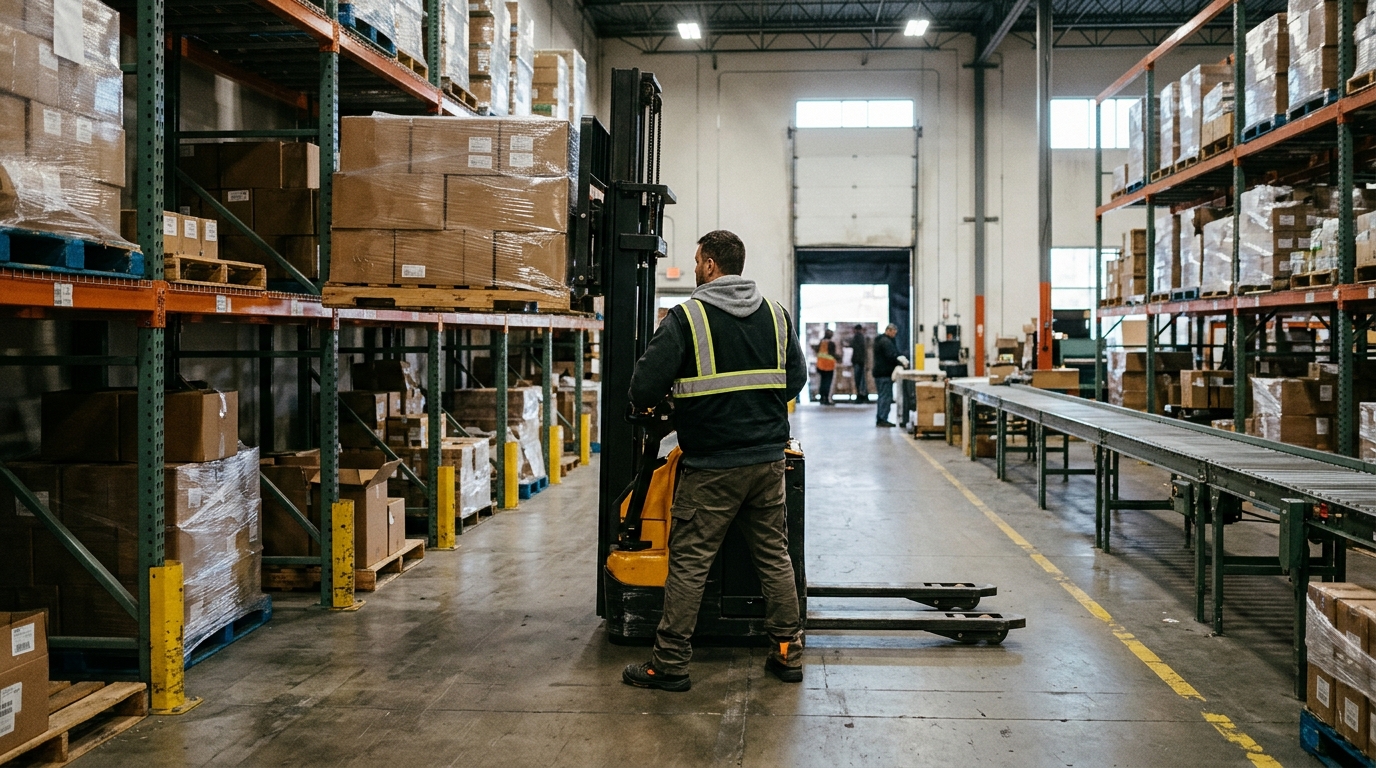
A warehouse resume is judged on three things: the equipment you can safely operate, the numbers that show how fast and accurately you work, and whether your availability matches the shift being filled. Most employers do not require a diploma — the Bureau of Labor Statistics lists the typical entry-level education for hand laborers and material movers as no formal educational credential, with no related work experience needed and short-term on-the-job training (U.S. Bureau of Labor Statistics, 2025).
That makes the resume a filtering document rather than a credential list. This guide shows what to put in each section, gives bullets you can adapt, and ends with a pre-submission checklist.
What Hiring Managers Look For
Warehouse hiring is high-volume and fast. A supervisor or recruiter scans for a short list of concrete things, and anything that is not on that list gets skipped.
Powered industrial truck (forklift) training. This is the single biggest differentiator on a warehouse resume. OSHA's powered industrial truck standard requires that the employer ensure each operator is competent to operate the truck safely, as demonstrated by successful completion of training and evaluation (OSHA, undated), and that each operator's performance is evaluated at least once every three years (OSHA, undated). A new employer will re-evaluate you, but prior training means you arrive able to run equipment on day one. Oregon OSHA states that a forklift operator certification must include the operator's name, the trainer's name, and the training and evaluation dates (Oregon OSHA, undated) — write your resume line the same way so it is obviously real. One forklift-training guide notes that under OSHA rules operators must be 18 or older for nonagricultural work (Boostpoint, undated).
Scanner and system experience. BLS describes these workers keeping track of a package number, sometimes with a hand-held scanner, to ensure proper delivery (U.S. Bureau of Labor Statistics, 2025), and ONET lists recording numbers of units handled or moved using daily production sheets or work tickets as a task for the occupation (ONET OnLine, undated). Name the hardware and software you have used — RF handheld scanners, ring scanners, warehouse management systems, voice-pick headsets — because a candidate who already knows the workflow needs less training time.
Specific equipment and material-handling skills. Beyond forklifts, ONET lists attaching slings, hooks, or other devices to lift cargo and guide loads (ONET OnLine, undated), and names operating vehicles, mechanized devices, or equipment such as forklifts as a core work activity (O*NET OnLine, undated). Electric pallet jack, order picker, reach truck, cherry picker, walkie rider, stretch wrapper and banding equipment are all worth listing by name.
Availability and physical reliability. BLS notes that shifts longer than eight hours are common for these workers, with overtime sometimes available (U.S. Bureau of Labor Statistics, undated), and ONET reports that 62% of respondents described a typical work week as more than 40 hours (ONET OnLine, undated). Stating which shifts you can work answers a question the hiring manager would otherwise have to call you about. Safety habits count too: ONET reports 80% of respondents wear common protective equipment such as safety shoes, glasses, gloves, hearing protection or hard hats every day (ONET OnLine, undated).
How to Write the Resume
Keep it to one page. Work through the sections in this order.
- Headline and summary. Put the posting's exact job title directly under your name, then two or three lines covering equipment, shift availability and one number. CareerOneStop lists alternate titles for this occupation including Laborer, Loader, Material Handler, Receiving Associate and Warehouse Worker (CareerOneStop, undated) — use whichever the posting uses, not your preferred one. Adapt: "Warehouse Worker with 3 years in high-volume distribution. Forklift and electric pallet jack operator, average 115 picks per hour on RF scanner. Available for 10- and 12-hour shifts, nights or weekends."
- Skills section. Make it a scannable two-column or comma-separated list of equipment, systems and processes — not adjectives. Group it: equipment, systems, processes. Adapt: "Sit-down counterbalance forklift, reach truck, electric pallet jack, order picker; RF handheld and ring scanners, warehouse management system data entry; receiving, put-away, picking, packing, cycle counting, shrink wrapping, loading and unloading trailers."
- Certifications and training. Give this its own short block so it is not buried. Write it as a certificate reads. Adapt: "Powered Industrial Truck Operator — sit-down counterbalance and reach truck. Trained and evaluated by [trainer name], [employer], March 2024. Re-evaluation due March 2027." If your training was employer-specific and you have left, say so plainly rather than implying a portable licence.
- Work experience. Reverse chronological, with employer, location, job title and month/year dates. Under each role, three to five bullets that each start with a verb and contain a number. Cover throughput, accuracy, equipment hours and safety. Adapt: "Loaded and unloaded an average of 18 inbound trailers per week, verifying carton counts against packing lists before sign-off." If your work came through staffing agencies, list the agency as the employer and name the site type ("third-party logistics distribution center, 400,000 sq ft") so the dates make sense.
- Education and other. One or two lines is enough — BLS lists no formal educational credential as the typical entry-level education and short-term on-the-job training as what is typically needed (U.S. Bureau of Labor Statistics, 2025). List a high school diploma or GED if you have one, then anything adjacent: safety training, CPR, a driver's licence class if the role involves yard moves. Adapt: "High school diploma, [School], 2019. Workplace safety and lockout/tagout orientation, 2023."
Example Resume Bullets
Swap in your own figures. If you do not know your numbers, estimate from a typical shift and say "approximately" — a defensible estimate beats no number.
Picking accuracy
Order picking with an RF scanner
Picked an average of 120 units per hour against a 100-unit standard across 10-hour shifts, scanning each item with an RF handheld to hold order accuracy at 99.8%.
Receiving volume
Inbound receiving
Unloaded 18 to 24 inbound trailers per week and verified roughly 1,200 cartons per day against packing lists, logging 15+ discrepancies per month on daily production sheets.
Forklift operation
Powered industrial truck work
Operated sit-down counterbalance and reach trucks up to 6 hours per shift, moving approximately 300 pallets a week into racking at heights to 25 feet with zero reportable incidents over 18 months.
Rigging and oversized loads
Slings, hooks and guided loads
Attached slings and hooks to lift cargo up to 2,000 lbs, guiding 15 to 20 oversized loads per month into position using a two-person spotter routine.
Inventory control
Cycle counting
Cycle-counted 500 SKUs per month and reduced location errors from roughly 40 per cycle to under 10 within two quarters.
Training others
Onboarding new associates
Trained 6 new associates on scanner workflow, pallet jack handling and PPE requirements, with each cleared to work unsupervised within 3 shifts.
Before You Submit
- Save the file as FirstLast_Resume.pdf, unless the posting asks for .docx.
- Copy the job title from the posting word for word into the headline under your name.
- Paste the posting into a blank document and highlight every noun that names equipment, software or a process, then confirm each one you have actually done appears somewhere in your resume text.
- Replace tables, text boxes, columns and logos with a single-column layout, and move your phone number and email out of the page header into the body — header text is often dropped when an applicant tracking system parses the file.
- Write each abbreviation both ways on first use: "radio frequency (RF) scanner," "warehouse management system (WMS)."
- Check that every work-experience bullet contains a number, percentage or quantity.
- Add one line stating the shifts you can work and whether you accept overtime.
- Confirm your forklift line shows the equipment type, trainer or employer, and the training and evaluation dates.
Frequently asked questions
Can I apply with no warehouse experience at all?
Yes. BLS lists work experience in a related occupation as none for hand laborers and material movers, with short-term on-the-job training typically provided (U.S. Bureau of Labor Statistics, 2025). Build your experience section from any job involving lifting, stocking, counting or deadlines — retail stocking, moving, landscaping, kitchen prep — and attach numbers to it.
How do I list a forklift certification from a previous employer?
Write it as training and evaluation rather than a transferable licence, naming the truck type, who trained you and the dates. OSHA requires each employer to ensure its own operators are competent and to re-evaluate performance at least once every three years (OSHA, undated), so a new employer will re-check you regardless — prior training still saves them time and signals you can start on equipment sooner.
Do I need a cover letter for a warehouse job?
Many warehouse applications are online forms with no cover letter field, so write the resume to stand alone. When there is a field, use four or five sentences: shift availability, equipment you can run, one throughput number, and your earliest start date. Skip background on why you admire the company.
Should I put a pay expectation on my resume?
Leave it off the resume and answer only if the application form requires it. BLS reported median pay for this occupation of $38,220 per year, or $18.38 per hour, in 2025 (U.S. Bureau of Labor Statistics, 2025), but actual rates sit above and below that depending on state, employer, shift differential and overtime — check current local job postings before naming a range.
How do I handle short stints through staffing agencies?
List the staffing agency as the employer, then name each site type and assignment length underneath so the dates read as assignments rather than job-hopping. Group several short assignments under one agency heading with a combined date range and one set of bullets covering the equipment and volumes across all of them.
Sources
- U.S. Bureau of Labor Statistics — Hand Laborers and Material Movers : Occupational Outlook Handbook (2025)
- U.S. Bureau of Labor Statistics — Hand Laborers and Material Movers : Occupational Outlook Handbook