What Does a Pharmacy Technician Do?
A look at the counting, labeling, insurance claims and inventory work behind every prescription, plus what it takes to get certified and hired.
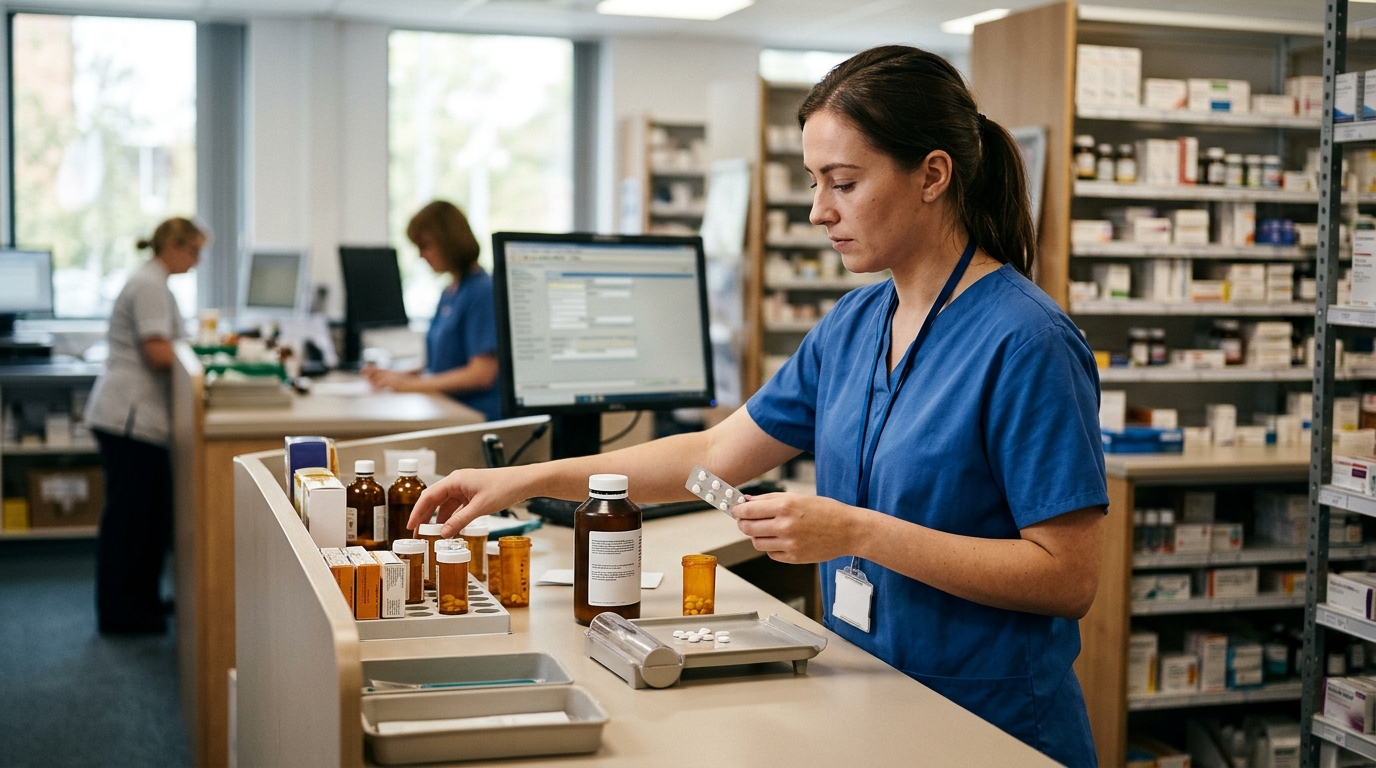
Pharmacy technicians help pharmacists dispense prescription medication to customers and health professionals, working mainly in retail pharmacies and hospitals (U.S. Bureau of Labor Statistics, undated). Day to day you collect prescription information, measure and package medication, label and record dosages, process insurance claims and keep inventory stocked, with a pharmacist reviewing every prescription before it reaches a patient (U.S. Bureau of Labor Statistics, undated).
Most states regulate the role, and requirements vary — some combination of a high school diploma or GED, a training program, an exam, fees, continuing education and a criminal background check (U.S. Bureau of Labor Statistics, undated).
What a Pharmacy Technician Does
Pharmacy technicians prepare medications under the direction of a pharmacist — measuring, mixing, counting out, labeling and recording amounts and dosages according to prescription orders (O*NET OnLine, undated). They mainly work in retail pharmacies, including those inside drug, general merchandise and grocery stores, and in hospitals (U.S. Bureau of Labor Statistics, undated).
The split between those two settings changes the work. In a retail drugstore you deal directly with customers, take payment and process insurance claims. In a hospital you fill unit-dose orders for inpatient floors, restock automated dispensing cabinets and work alongside nursing staff.
Everything a technician prepares passes to a pharmacist, who must review the prescription before it is given to a patient (U.S. Bureau of Labor Statistics, undated). Technicians may also operate automated dispensing equipment. Specialized versions of the job exist: reported titles include Chemotherapy Pharmacy Technician, Compounding Technician, OR Pharmacy Tech and Registered Pharmacy Technician (O*NET Code Connector, undated).
Core Duties and Responsibilities
- Collect the information needed to fill a prescription, including patient details and prescriber instructions (U.S. Bureau of Labor Statistics, undated).
- Measure, mix and count out amounts of medication according to the prescription order (O*NET OnLine, undated).
- Package and label prescriptions, recording the amount and dosage dispensed.
- Enter patient information into the pharmacy computer system.
- Accept payment from customers and process insurance claims, including resolving rejected claims.
- Organize inventory on shelves and in refrigerated storage, and alert the pharmacist to shortages of medications or supplies.
- Operate automated dispensing equipment and restock cassettes or cabinets (U.S. Bureau of Labor Statistics, undated).
- Answer phone calls from customers, prescribers' offices and other pharmacies.
- Refer every clinical question and all counseling requests to the supervising pharmacist.
- Pull expired or recalled stock and document its removal.
A Typical Day
Opening (retail, around 8–9 AM) — Unlock the pharmacy, log into the dispensing system, print the overnight queue of electronic prescriptions and start filling the easiest refills first.
Mid-morning — Work the drop-off window: collect prescription information from walk-in patients, enter insurance details and run claims. Rejected claims go to a hold list for follow-up calls.
Late morning — Receive and check in the wholesaler delivery, match it against the invoice, put refrigerated items away first and flag any short-dated stock.
The unpredictable part — A drug comes up out of stock mid-fill. You check nearby stores, call the prescriber's office about a therapeutic alternative, and hand the decision to the pharmacist, who must review the change.
Early afternoon — Count out and label a batch of maintenance refills, then stage completed bags in the will-call bins alphabetically.
Mid-afternoon — Field phone calls: refill requests, delivery questions, transfers from other pharmacies.
End of shift — Return unclaimed prescriptions to stock, reverse their insurance claims, run cycle counts on controlled substances and hand off the open queue to the next shift.
Work Environment
- Indoors, behind a pharmacy counter in a drug, general merchandise or grocery store, or in a hospital pharmacy department (U.S. Bureau of Labor Statistics, undated).
- Standing for most of the shift, moving between the counter, shelving and the dispensing machine; stooping and reaching to high and low shelves is constant.
- Lifting cases of bottled liquids, IV fluid boxes and delivery totes — check the specific weight limit in each employer's job posting, as it varies.
- Most technicians work full time, but many work part time (U.S. Bureau of Labor Statistics, undated); retail pharmacies inside 24-hour stores and hospital pharmacies schedule evenings, weekends and holidays.
- Noise comes from the store floor, printers, phones and automated dispensing equipment rather than machinery; hospital cleanroom work adds gowning, gloves and hood airflow.
- Travel is essentially zero — the job is fixed to one site, though some technicians float between branches of the same chain.
Skills and Qualifications
| Requirement | Detail |
|---|---|
| High school diploma or GED | The usual minimum; technicians typically then learn duties through on-the-job training, with the length of training set by the employer (U.S. Bureau of Labor Statistics, undated) |
| Postsecondary pharmacy technician certificate | Offered by vocational schools and community colleges; most often awards a certificate after 1 year or less (U.S. Bureau of Labor Statistics, undated) |
| Associate's degree in pharmacy technology | Some programs run longer than a year and award an associate's degree instead of a certificate (U.S. Bureau of Labor Statistics, undated) |
| ASHP-accredited program | Accredited programs include at least 600 hours of instruction over a minimum of 15 weeks; 309 fully accredited programs existed in 2017, a few run by retail drugstore chains (U.S. Bureau of Labor Statistics, 2017) |
| Certified Pharmacy Technician (CPhT) — PTCB | Requires a high school diploma and passing the PTCE: 90 multiple-choice questions, passing score 1,400, covering Medications (40%), Patient Safety and Quality Assurance (26.25%), Order Entry and Processing (21.25%) and Federal Requirements (12.5%); $129 application and exam fee, 90-day scheduling window after approval (Ultimate Medical Academy, undated; MedPreps, 2026) |
| Certification through the National Healthcareer Association | Applicants must be at least 18, hold a high school diploma, and have completed a training program or have 1 year of work experience; recertify every 2 years with 20 hours of continuing education (U.S. Bureau of Labor Statistics, undated) |
| CPhT recertification | 20 hours of continuing education every 2 years, including at least 2 hours in pharmacy law and 1 hour in patient safety, plus a $55 fee (Stepful, undated) |
| State registration or license | Most states regulate technicians; requirements typically include some or all of a diploma or GED, a training program, an exam, fees, continuing education and a criminal background check (U.S. Bureau of Labor Statistics, undated). Titles and agencies differ — Vermont issues a 'Pharmacy Technician' license through the Secretary of State Pharmacy Board, Alabama a 'Licensed Pharmacist Technician' through its Board of Pharmacy (O*NET OnLine, undated) |
| Advanced Certified Pharmacy Technician (CPhT-Adv) | Needs active CPhT plus 3 years of experience within the past 8 years and four PTCB Assessment-Based Certificate Programs, or three plus the CSPT certification; no exam (Pharmacy Technician Certification Board, undated) |
Salary and Job Outlook
| Measure | Figure | Source |
|---|---|---|
| Entry-level (10th percentile) | $36,020 a year / $17.32 an hour | CareerOneStop, May 2025 |
| Median | $45,750 a year / $22.00 an hour | CareerOneStop, May 2025 |
| Experienced (90th percentile) | $61,040 a year / $29.35 an hour | CareerOneStop, May 2025 |
| Jobs in the occupation | 471,680 wage-and-salary jobs (SOC 29-2052) | BLS Occupational Employment and Wage Statistics, May 2025 |
| Projected growth | 6 percent, 2025 to 2035, adding roughly 30,100 jobs | BLS Occupational Outlook Handbook, 2025 |
| Annual openings | About 44,700 a year | BLS Occupational Outlook Handbook, 2025 |
Pay is normally hourly in both retail and hospital settings, with shift differentials for evenings, nights and weekends in hospitals and some 24-hour stores. Certification and sterile-compounding skills are often what move a technician up a chain's pay scale. Rates vary widely by state and metro area, so check the current figures for your own location on CareerOneStop or the BLS Occupational Employment and Wage Statistics tables before you negotiate.
How to Get Started
- Finish a high school diploma or GED — the usual minimum for both employment and certification (U.S. Bureau of Labor Statistics, undated).
- Check your state's rules. Contact your state board of pharmacy, since most states regulate technicians and the requirements may include a training program, an exam, fees, continuing education and a criminal background check (U.S. Bureau of Labor Statistics, undated). Titles differ by state — Vermont's Pharmacy Board issues a 'Pharmacy Technician' license, Alabama a 'Licensed Pharmacist Technician' (O*NET OnLine, undated).
- Choose a training route: on-the-job training with an employer, or a vocational school or community college program awarding a certificate in a year or less. ASHP-accredited programs run at least 600 hours over a minimum of 15 weeks (U.S. Bureau of Labor Statistics, undated).
- Qualify to sit the PTCE either by completing a PTCB Recognized Education/Training Program or by logging a minimum of 500 hours of equivalent pharmacy technician work experience; apply and pay the $129 fee, then schedule within the 90-day window (MedPreps, 2026).
- Pass the PTCE — 90 multiple-choice questions, score 1,400 or higher (Ultimate Medical Academy, undated) — or certify through the NHA if you are 18 or older with a training program or 1 year of experience (U.S. Bureau of Labor Statistics, undated).
- Apply to retail pharmacies in drug, grocery and general merchandise stores and to hospital pharmacy departments, then keep certification current with 20 hours of continuing education every 2 years, including 2 hours of pharmacy law and 1 hour of patient safety, plus the $55 renewal fee (Stepful, undated).
Frequently asked questions
Do you need a degree to become a pharmacy technician?
No. A high school diploma or equivalent is usually enough, with duties learned through on-the-job training whose length varies by employer (U.S. Bureau of Labor Statistics, undated). If you prefer formal study, vocational schools and community colleges most often award a certificate in a year or less, and some longer programs lead to an associate's degree.
How long does PTCB certification take?
It depends on your eligibility route. One path is finishing a PTCB Recognized Education/Training Program — you can apply up to 60 days before you finish — and the other is logging at least 500 hours of equivalent pharmacy technician work experience (MedPreps, 2026). Once your $129 application is approved you have a 90-day window to schedule the 90-question exam.
What is the difference between retail and hospital pharmacy technician work?
Retail work puts you at the counter taking payment, processing insurance claims and answering customer phone calls, while hospital work centers on filling inpatient orders, restocking automated dispensing cabinets and, in some roles, sterile compounding (U.S. Bureau of Labor Statistics, undated). Hospital schedules more often include nights and weekends with shift differentials. Specialized hospital titles include Chemotherapy Pharmacy Technician and OR Pharmacy Tech (O*NET Code Connector, undated).
Is this a growing field?
Employment is projected to grow 6 percent from 2025 to 2035, adding roughly 30,100 jobs, with about 44,700 openings a year as technicians change occupations or retire (BLS Occupational Outlook Handbook, 2025). The occupation counted 471,680 wage-and-salary jobs in May 2025 (BLS Occupational Employment and Wage Statistics).
Can a pharmacy technician advance without going to pharmacy school?
Yes — the Advanced Certified Pharmacy Technician (CPhT-Adv) credential requires an active PTCB CPhT plus at least 3 years of experience within the past 8 years and four PTCB Assessment-Based Certificate Programs, or three plus the Compounded Sterile Preparation Technician (CSPT) certification (Pharmacy Technician Certification Board, undated). There is no exam for CPhT-Adv. Lead technician, buyer and training roles are other common moves.
Sources
- U.S. Bureau of Labor Statistics — Pharmacy Technicians : Occupational Outlook Handbook
- Ultimate Medical Academy — Pharmacy Technician Certification (CPhT): Your Guide to the PTCE Exam