What Does a Welder Do? Duties, Skills, and Work Environment
From reading blueprints to laying a finished bead, here is the hands-on reality of joining and cutting metal, plus the shifts and protective gear that come with it.
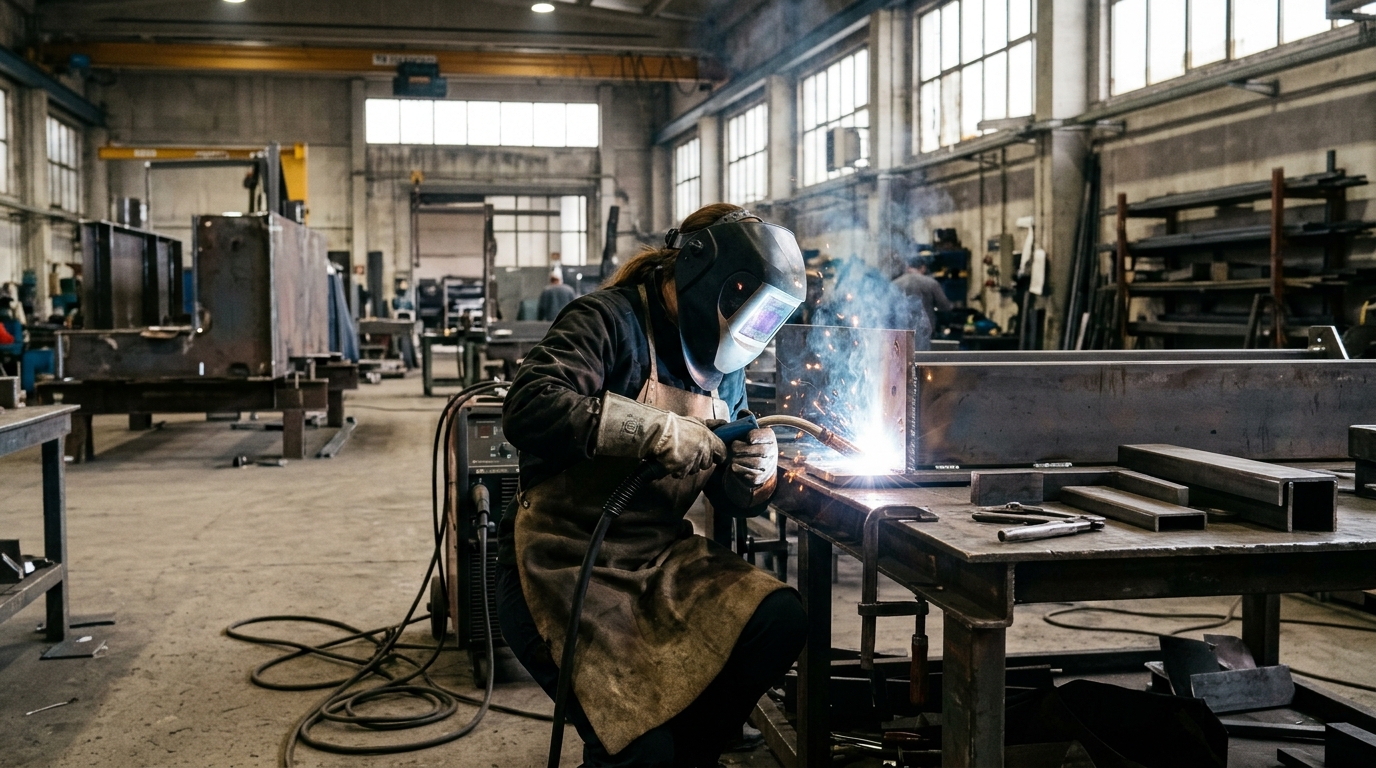
A welder uses hand-held or remotely controlled equipment to join or cut metal parts, working from blueprints and written specifications (U.S. Bureau of Labor Statistics, 2025). The job mixes measuring, fitting and inspecting with the actual arc time, and it happens in manufacturing plants, fabrication shops, shipyards, construction sites and pipeline right-of-ways.
Entry usually starts with a high school diploma or equivalent plus on-the-job training, and many plants run shifts around the clock, so nights and weekends are part of the picture (U.S. Bureau of Labor Statistics, 2025).
What a Welder Does
Welders join or cut metal parts using hand-held or remotely controlled equipment (U.S. Bureau of Labor Statistics, 2025). In practice that means turning a drawing into a finished assembly: reading the print, measuring and marking the stock, clamping or tacking parts into position, then running the weld to the specification the drawing calls for.
Where that happens varies more than the work itself. In a manufacturing plant you may weld the same subassembly repeatedly on a fixture, to a set cycle time. In a fabrication shop you might work from one-off prints for a customer. On a construction site, in a shipyard, or on a pipeline crew, you weld in place — overhead, in trenches, on scaffolding — and the inspection standard is usually tighter.
You rarely work alone. Welders take direction from fitters, supervisors and inspectors, and hand off to painters, machinists or quality staff. On code work, your weld is checked visually and sometimes tested before the job moves on.
Related roles in the same occupation group include cutters, solderers and brazers (U.S. Bureau of Labor Statistics, 2025).
Core Duties and Responsibilities
- Read and interpret blueprints, weld symbols and written specifications before striking an arc (U.S. Bureau of Labor Statistics, 2025).
- Calculate and measure dimensions on parts to be welded, and mark or lay out material from the print (U.S. Bureau of Labor Statistics, 2025).
- Inspect structures and materials for flaws, fit-up gaps and contamination before and after welding (U.S. Bureau of Labor Statistics, 2025).
- Weld components in flat, vertical, horizontal or overhead positions to the specification on the drawing (U.S. Bureau of Labor Statistics, 2025).
- Monitor the welding process and adjust heat, voltage, wire speed and gas flow so the metal does not warp, undercut or burn through (U.S. Bureau of Labor Statistics, 2025).
- Operate the process the job calls for — stick (SMAW), MIG (GMAW), flux-cored (FCAW) or TIG (GTAW) — and change consumables, electrodes and shielding gas to match the base metal.
- Cut and trim metal with an oxy-fuel torch, plasma cutter, grinder or cut-off saw.
- Clamp, tack and fixture parts so the assembly holds alignment while you weld out the joint.
- Maintain and repair welding machines, torches, leads, regulators and extraction equipment (U.S. Bureau of Labor Statistics, 2025).
- Grind, wire-brush and clean finished welds, then log work, heat numbers or inspection results as the job requires.
A Typical Day
Start of shift
Clock in, review the work order or print packet, and check the machine: ground clamp, leads, gas bottle pressure, wire feed. Put on the hood, jacket, gloves and respirator or face protection the job calls for — protective equipment is worn every day in this occupation (O*NET OnLine, U.S. Department of Labor).
First two hours
Lay out and fit the first assembly. Measure from the print, mark, clamp and tack. On repeat production work you load the fixture and start running parts to cycle time.
Mid-morning
Steady arc time. You stop to clean spatter, change wire or electrodes, adjust amperage as the plate heats, and check fit-up on the next piece while the last one cools.
The unpredictable part
A weld fails visual inspection, a part arrives out of tolerance, or a machine starts feeding erratically. You gouge out the bad section and reweld, shim the fit-up, or swap a liner and contact tip — and the rest of the day's schedule shifts around it.
Afternoon
Weld out the remaining joints, grind and dress the finished work, and present pieces to the inspector or supervisor.
End of shift
Shut down gas, coil leads, sweep the booth, restock consumables, and write up progress or hand over to the next crew on a round-the-clock operation.
Work Environment
- Indoors in a shop or plant, or outdoors on construction, shipyard and pipeline work, where conditions include weather and confined or awkward positions (U.S. Bureau of Labor Statistics, 2025).
- Standing, bending, stooping, kneeling and reaching for most of the shift, often holding a position while welding overhead or in tight spaces (U.S. Bureau of Labor Statistics, 2025).
- Exposure to contaminants — welding fume, dust and grinding particulate — every day (O*NET OnLine, U.S. Department of Labor).
- Distracting or uncomfortable noise levels every day from grinders, hammering, air tools and plant machinery (O*NET OnLine, U.S. Department of Labor).
- Common protective and safety equipment worn every day: welding helmet with the correct shade lens, flame-resistant jacket and gloves, safety glasses, steel-toe boots and hearing protection (O*NET OnLine, U.S. Department of Labor).
- Many manufacturing firms run shifts so production continues around the clock, which means nights, weekends and rotating schedules in some plants (U.S. Bureau of Labor Statistics, 2025). Travel ranges from none for shop work to near-continuous for pipeline and field crews — ask about it at interview.
Skills and Qualifications
| Requirement | Detail |
|---|---|
| High school diploma or equivalent | The typical entry-level education for the occupation (U.S. Bureau of Labor Statistics, 2025). Usually four years, or several months for a GED. |
| On-the-job training | Typically required after hire (U.S. Bureau of Labor Statistics, 2025). Length depends on the employer and the processes you need; ask how long their training period runs. |
| Technical or vocational school welding program | A named training pathway for the occupation (U.S. Bureau of Labor Statistics, 2025). Program length varies widely by school — confirm the hours and the processes taught before enrolling. |
| Apprenticeship | Another named pathway, combining paid work with instruction (U.S. Bureau of Labor Statistics, 2025). Duration is set by the sponsoring employer or union; check with the sponsor. |
| OSHA safety training | Employers commonly require OSHA safety training, and some welding work is subject to licensing (U.S. Bureau of Labor Statistics, 2025). The 10-hour course is typically completed in one to two days; licensing rules differ by state and city. |
| Welder performance qualification test | Many employers and code jobs require you to pass a hands-on test in the position, process and material of the job. Usually a few hours, retested periodically. |
| Blueprint reading and shop math | Needed to calculate and measure dimensions and interpret weld symbols (U.S. Bureau of Labor Statistics, 2025). Often one term in a welding program. |
| Physical stamina, manual dexterity and spatial-orientation skill | Qualities the Bureau of Labor Statistics names as important for the occupation (2025). Built through practice rather than certified. |
Salary and Job Outlook
Pay for welders is usually hourly, with overtime after 40 hours, shift differentials for nights, and per diem on travel jobs. Rates vary by state, industry and whether the work is code-certified or production. Check the figures below before you negotiate — they are updated annually.
| Figure | What it covers and where to find it |
|---|---|
| Entry-level pay | The lowest 10 percent of earners in the occupation is published by the U.S. Bureau of Labor Statistics (2025) in the Occupational Outlook Handbook. |
| Median pay | The median annual wage for welders, cutters, solderers and brazers is published by the U.S. Bureau of Labor Statistics (2025); the same page gives the median for all occupations for comparison. |
| Experienced pay | The highest 10 percent of earners is published by the U.S. Bureau of Labor Statistics (2025); state and metro breakdowns appear in its Occupational Employment and Wage Statistics tables. |
| Projected growth | Projected employment change for 2025-2035, plus projected annual job openings over the decade and the current number of jobs held, all from the U.S. Bureau of Labor Statistics (2025). |
How to Get Started
- Finish a high school diploma or equivalent, the typical entry-level education for the occupation, and take shop math, geometry and any metalworking class offered (U.S. Bureau of Labor Statistics, 2025).
- Enroll in a technical or vocational school welding program, or apply to an apprenticeship — both are named training pathways for welders (U.S. Bureau of Labor Statistics, 2025). Ask each program which processes it covers: SMAW, GMAW, FCAW and GTAW.
- Complete OSHA safety training, commonly required by employers, and check your state and city licensing rules for the kind of welding you want to do (U.S. Bureau of Labor Statistics, 2025).
- Build a basic kit and a sample set: helmet, flame-resistant jacket, gloves, boots, and coupons showing fillet and groove welds in more than one position.
- Pass a welder performance qualification test in the position and process your target employers use. Most shops test applicants on site; ask what the test involves when you apply.
- Apply directly to fabrication shops, manufacturing plants, shipyards and construction contractors, and register with the apprenticeship sponsors or union halls in your area.
Frequently asked questions
How long does it take to become a welder?
It depends entirely on the route. The typical entry requirement is a high school diploma or equivalent plus on-the-job training, so some people start in a production shop within weeks of applying (U.S. Bureau of Labor Statistics, 2025). A technical school program or an apprenticeship takes longer but covers more processes and positions — ask each provider for its exact hours, because program length varies widely.
Do welders need a license or certification?
Some welding work is subject to licensing, and employers commonly require OSHA safety training (U.S. Bureau of Labor Statistics, 2025). Separately, most employers and all code work require you to pass a welder performance qualification test in the specific process, position and material of the job. Licensing rules differ by state and city, so check with your state's licensing board rather than assuming.
Is welding hard on your body?
Expect to stand, bend, stoop and kneel for most of a shift, sometimes in cramped positions or outdoors in weather (U.S. Bureau of Labor Statistics, 2025). You are also exposed to contaminants and uncomfortable noise levels every day, which is why protective equipment is worn every day in this occupation (O*NET OnLine, U.S. Department of Labor). Proper fume extraction, hearing protection and the correct lens shade matter more than toughing it out.
What shifts do welders work?
Many manufacturing firms run shifts so production continues around the clock, which means nights, weekends and rotating schedules are normal in plant work (U.S. Bureau of Labor Statistics, 2025). Shop and maintenance jobs are more often a fixed day shift. Field and pipeline work can involve long stretches away from home, so ask about travel and overtime expectations before you accept an offer.
Which industries hire the most welders?
Welders work across manufacturing plants, fabrication shops, construction sites, shipyards and pipeline projects; the Bureau of Labor Statistics publishes the list of largest employing industries and the total number of jobs held in the occupation (2025). It also projects employment change for 2025-2035 and the number of job openings expected each year over the decade. Check those tables for the current picture in your state.
Sources
- U.S. Bureau of Labor Statistics — Welders, Cutters, Solderers, and Brazers : Occupational Outlook Handbook (2025)
- O*NET OnLine (U.S. Department of Labor) — 51-4121.00 - Welders, Cutters, Solderers, and Brazers