How to Become a Veterinary Technician: Step-by-Step Guide
Veterinary technicians train in an AVMA-accredited program, sit a national exam, then apply to a state board — here is what each stage asks of you.
Becoming a veterinary technician usually means completing a veterinary technology program accredited by the AVMA Committee on Veterinary Technician Education and Activities (CVTEA), passing the Veterinary Technician National Examination (VTNE) administered by the American Association of Veterinary State Boards, and then applying to your state board to be registered, licensed, or certified. The U.S. Bureau of Labor Statistics lists an associate's degree as the typical entry-level education for the occupation (2025), which puts most people about two years of full-time study away from their first credentialed job.
The work is clinical and physical: restraining animals, running lab tests, monitoring anesthesia, and taking radiographs. Exact credential names and renewal rules differ by state, so the state board where you intend to work is the authority on what you need.
What the Job Actually Involves
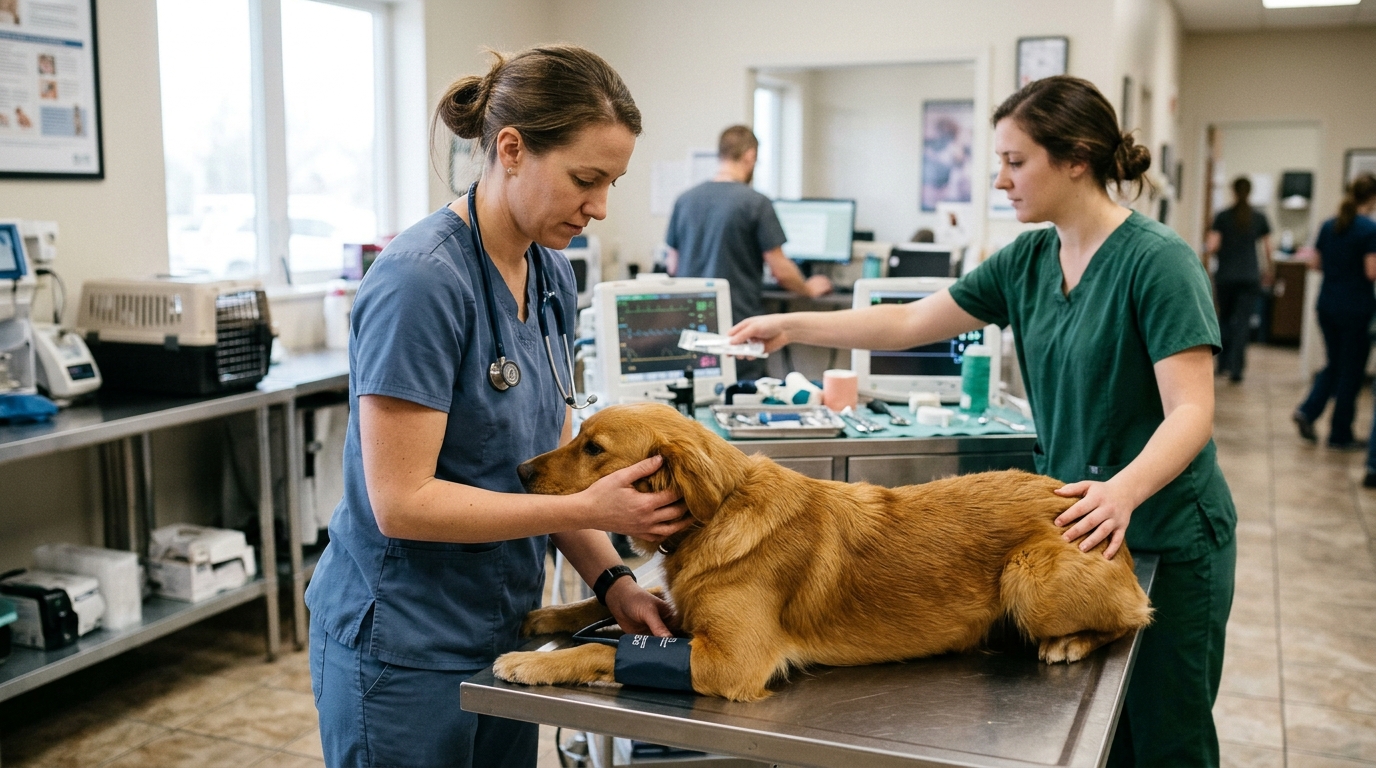
Most of the job happens in a treatment area, standing up. A representative weekday in a small-animal practice runs something like this:
- Morning: check inpatients, record temperature, pulse and respiration, observe animal behavior and condition, and update case histories in the clinic's practice-management software.
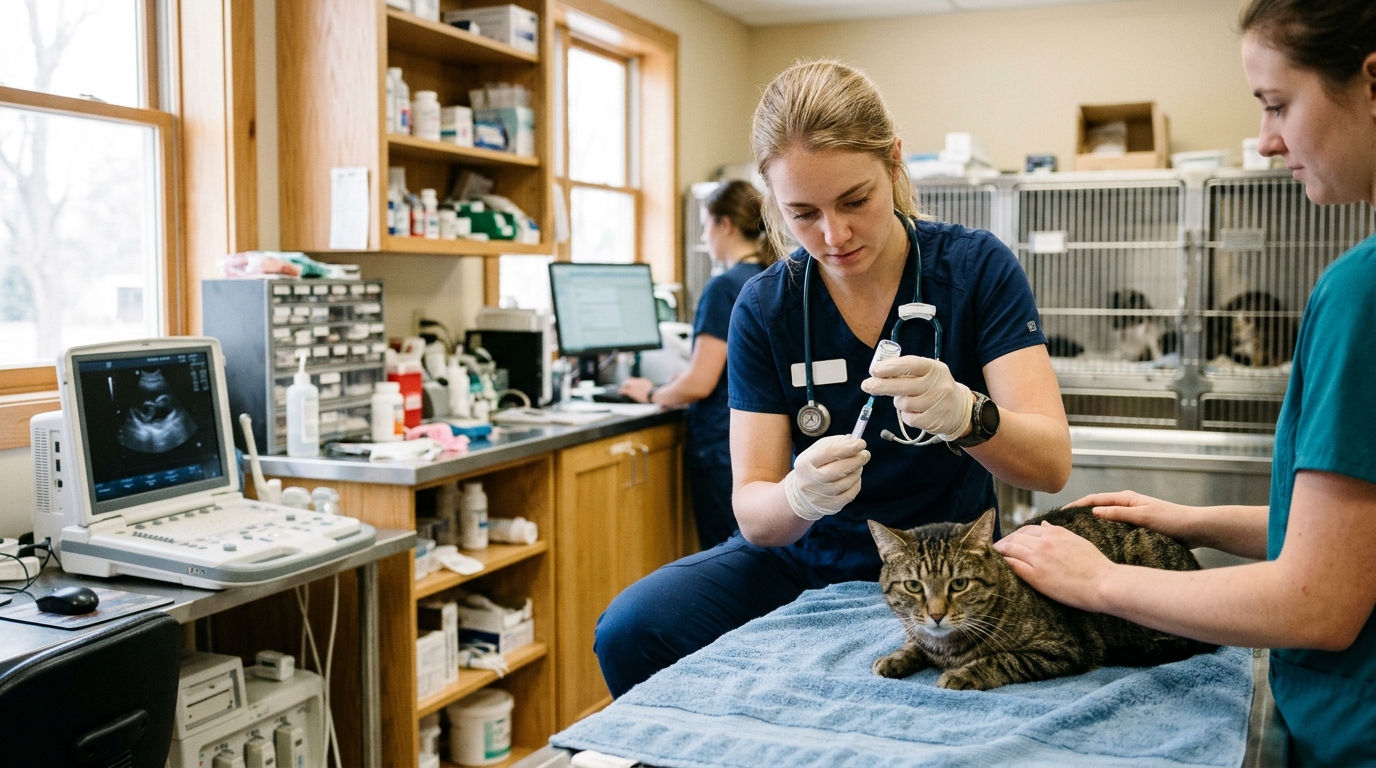
- Mid-morning: restrain animals during exams, place intravenous catheters, draw blood, and run lab tests such as urinalyses and blood counts using a bench hematology analyzer, centrifuge and microscope.
- Surgery block: prepare animals and instruments for surgery, run instrument packs through the autoclave, induce and administer anesthesia, and monitor responses on a multiparameter monitor with pulse oximetry, ECG and capnography.
- Afternoon: take x-rays with a digital radiography unit, administer medications and vaccines, perform dental scaling and charting, and give nursing care or emergency first aid to animals that come in unscheduled.
- End of shift: discharge calls, controlled-drug logs, restocking, and cleaning.
Those duties are the core of the occupation as described by the U.S. Bureau of Labor Statistics (2025). The mix shifts with the setting. About 89 percent of veterinary technologists and technicians worked in the veterinary services industry, mainly private clinics and animal hospitals, while others work in laboratories, colleges and universities, and humane societies (U.S. Bureau of Labor Statistics, 2025). Research and teaching roles lean toward colony health records and protocol compliance; shelter roles lean toward intake exams, spay-neuter surgical support and vaccination clinics.
Schedules are not uniformly nine-to-five. Veterinary technologists and technicians may have to work evenings, weekends, or holidays (U.S. Bureau of Labor Statistics, 2025). Emergency and referral hospitals staff overnight, often on 10- or 12-hour shifts with rotating weekends; general practices more often run 8- to 10-hour weekday shifts with a Saturday rotation. Travel is uncommon in clinic roles and routine in large-animal or ambulatory practice, where you load the truck and work out of it.
Two things to weigh before you commit. The work carries physical risk: the occupation has one of the highest rates of injuries and illnesses of all occupations (U.S. Bureau of Labor Statistics, 2025), from bites, scratches, lifting and radiation or anesthetic-gas exposure. And the work is steady — the occupation held about 131,400 jobs in 2025, with employment projected to grow 9 percent from 2025 to 2035 and about 13,400 openings projected each year on average over the decade (U.S. Bureau of Labor Statistics, 2025).
Step-by-Step Path to Entry
- Confirm what your state requires, before you spend anything. Both technologists and technicians typically must pass a credentialing exam and become registered, licensed, or certified depending on the requirements of the state in which they work (U.S. Bureau of Labor Statistics, 2025). Titles differ — RVT, LVT, CVT — and so do application fees and renewal rules. Your state veterinary board is the authority; the BLS also points readers to CareerOneStop's certification finder for credential details (2025). Allow a week.
- Choose an AVMA CVTEA-accredited program. CVTEA accredits veterinary technology programs and lists them by state with a status such as 'Full Accreditation' or 'Initial Accreditation' (AVMA). Initial Accreditation is the term for newly accredited programs during their first five years and means the program is officially accredited (AVMA). Distance-education programs are listed as a separate accredited category alongside on-campus programs (AVMA). Shortlisting takes 2 to 4 weeks.
- Apply and complete the degree. Veterinary technicians need a 2-year associate's degree; veterinary technologists usually need a 4-year bachelor's degree, both completed in a postsecondary veterinary technology program (U.S. Bureau of Labor Statistics, 2025). Tuition varies by institution, state residency and whether the program is public or private — use the school's published tuition schedule and net price calculator for a current figure. Programs include required hands-on clinical skills and a preceptorship.
- Work as a veterinary assistant while you study (parallel, optional). This step can run alongside steps 2 and 3. It does not replace the degree in states that require accredited-program graduation, but it builds restraint, venipuncture and client-communication skills that employers look for in new graduates.
- Apply for the VTNE through the American Association of Veterinary State Boards. The application fee is $375, or you redeem a voucher when you submit; all sales are final and nonrefundable (AAVSB, 2026). You can reschedule to the next window once for a $90 fee up to 48 hours before your scheduled exam time, and you forfeit the fee if you do not test during your applied window (AAVSB, 2026). Apply during your final term; exams run in set windows.
- Sit and pass the VTNE. Budget 8 to 12 weeks of structured review alongside coursework.
- Apply to your state board for the credential. You will typically submit transcripts, your VTNE result, an application fee set by the board, and consent to a background check. Processing commonly takes several weeks; check your board for current timelines and fees.
- Apply for jobs and keep the credential current. Start applying 1 to 2 months before graduation. Renewal cycles and continuing-education hour requirements are set by each state board.
Steps 1 and 2 can overlap. Step 5 cannot start before you are eligible under your program and board rules, and step 7 cannot start before step 6.
Education and Certification Options Compared
| Path | Credential earned | Typical duration | Typical cost | Satisfies state credentialing? |
|---|---|---|---|---|
| AVMA CVTEA-accredited on-campus associate program (e.g. Community College of Denver's Veterinary Technology AAS, which holds full CVTEA accreditation) | Associate of Applied Science in Veterinary Technology | About 2 years full time | Tuition varies by institution and residency; check the college's published rate | Meets the degree requirement in most states — confirm with your state board |
| AVMA CVTEA-accredited distance-education associate program (listed by CVTEA as a separate accredited category) | Associate degree in Veterinary Technology | 2 to 4 years, often part time | Varies by institution; clinical site and travel costs are additional | Usually yes where CVTEA accreditation is accepted; verify with your state board |
| AVMA CVTEA-accredited bachelor's program | Bachelor's degree in Veterinary Technology (technologist route) | 4 years | Varies by institution and residency | Yes, where the board accepts CVTEA-accredited graduation |
| Veterinary Technician National Examination (AAVSB) | Passing VTNE result reported to your state board | One exam window; 8 to 12 weeks of prep is common | $375 application fee; $90 one-time reschedule (AAVSB, 2026) | Required by most states as the credentialing exam |
| State board application | RVT, LVT or CVT, depending on the state | Several weeks of processing | Board application fee varies by state | This is the credential itself |
| On-the-job veterinary assistant work | No formal credential | Ongoing | No tuition | No — does not substitute for an accredited degree in states that require one |
The measurable difference between the associate and bachelor's routes is two additional years of study and tuition for the same entry-level clinical duties; the bachelor's is the stated requirement for the technologist title (U.S. Bureau of Labor Statistics, 2025). The measurable difference between on-campus and distance programs is scheduling and the need to arrange your own approved clinical site, not accreditation status — CVTEA accredits both.
Requirements Checklist Before You Apply
Work through this before you send a single application.
- Hold a diploma or degree from a veterinary technology program with AVMA CVTEA accreditation status of Full Accreditation or Initial Accreditation.
- Have an official transcript available for release to your state board.
- Have a passing VTNE result on file with the American Association of Veterinary State Boards, with scores released to the correct state board.
- Hold the current credential your state issues — RVT, LVT or CVT — and know its renewal date and continuing-education hour requirement.
- Be able to pass a criminal background check if your state board or employer requires one; some boards also ask about prior disciplinary action on any professional license.
- Confirm legal eligibility to work in the United States with the employer's standard onboarding documentation.
- Hold a valid driver's license if you are applying to large-animal, ambulatory or shelter-transport roles.
- Be able to meet the physical demands stated in the job posting, including lifting and restraint, given that this occupation has one of the highest rates of injuries and illnesses of all occupations (U.S. Bureau of Labor Statistics, 2025).
- Have documented rabies pre-exposure vaccination status or be willing to obtain it where the employer requires it.
- Have logged clinical skills or a preceptorship record from your program that you can describe task by task in an interview.
- Have written availability for evenings, weekends and holidays, which the occupation commonly requires (U.S. Bureau of Labor Statistics, 2025).
Frequently asked questions
How long does it take to become a veterinary technician?
Plan on about two years of full-time study for an associate's degree, which the U.S. Bureau of Labor Statistics lists as the typical entry-level education (2025). Add roughly 8 to 12 weeks of VTNE preparation during your final term and several weeks for state board processing after you pass. The technologist route requires a 4-year bachelor's degree instead.
What does the VTNE cost, and what happens if I miss my exam date?
The application fee is $375, or you redeem a voucher when you apply, and all sales are final and nonrefundable (American Association of Veterinary State Boards, 2026). You can reschedule to the next window once for $90, up to 48 hours before your scheduled exam time. If you do not test during your applied window, you forfeit the exam fee.
Can I qualify without going to school if I already work in a clinic?
Assistant experience is useful but does not replace the degree in states that require graduation from an accredited program. Both technologists and technicians typically must pass a credentialing exam and become registered, licensed or certified according to their state's requirements (U.S. Bureau of Labor Statistics, 2025). Check your state board, since a small number of states have alternate eligibility routes.
Is an online veterinary technology program accepted?
AVMA CVTEA lists distance-education veterinary technology programs as a separate accredited category alongside on-campus programs. The accreditation status is what state boards look at, not the delivery format. You will still complete hands-on clinical hours at an approved site you arrange yourself, so confirm site availability before enrolling and verify acceptance with your state board.
What is the job outlook and typical pay?
Employment is projected to grow 9 percent from 2025 to 2035, much faster than the average for all occupations, with about 13,400 openings projected each year on average over the decade (U.S. Bureau of Labor Statistics, 2025). The median annual wage was $47,380 in May 2025, with the lowest 10 percent under $35,710 and the highest 10 percent over $63,180. Check the BLS page for current figures.
Does a program with 'Initial Accreditation' count?
Yes. Initial Accreditation, formerly called Provisional, is the term given to newly accredited veterinary technology programs for their first five years, and it means the program is officially accredited (AVMA). Confirm the listed status on the CVTEA program list for your state before you enroll, and ask the program how its graduates have fared with your state board.
Sources
- U.S. Bureau of Labor Statistics — Veterinary Technologists and Technicians : Occupational Outlook Handbook (2025-05)
- American Association of Veterinary State Boards (AAVSB) — Applying to Take the VTNE® (2026-10-23)